

3 October 2026
You are already advertising. The account looks healthy, and the next conversation is about increasing the budget. Before approving it, you need an answer to a different question: what happens to the business if the additional spend works? More orders can require more stock, absorb more cash and change the products or customers responsible for the result. An attractive campaign report can leave those questions unanswered.
Start with the decision, then choose the numbers
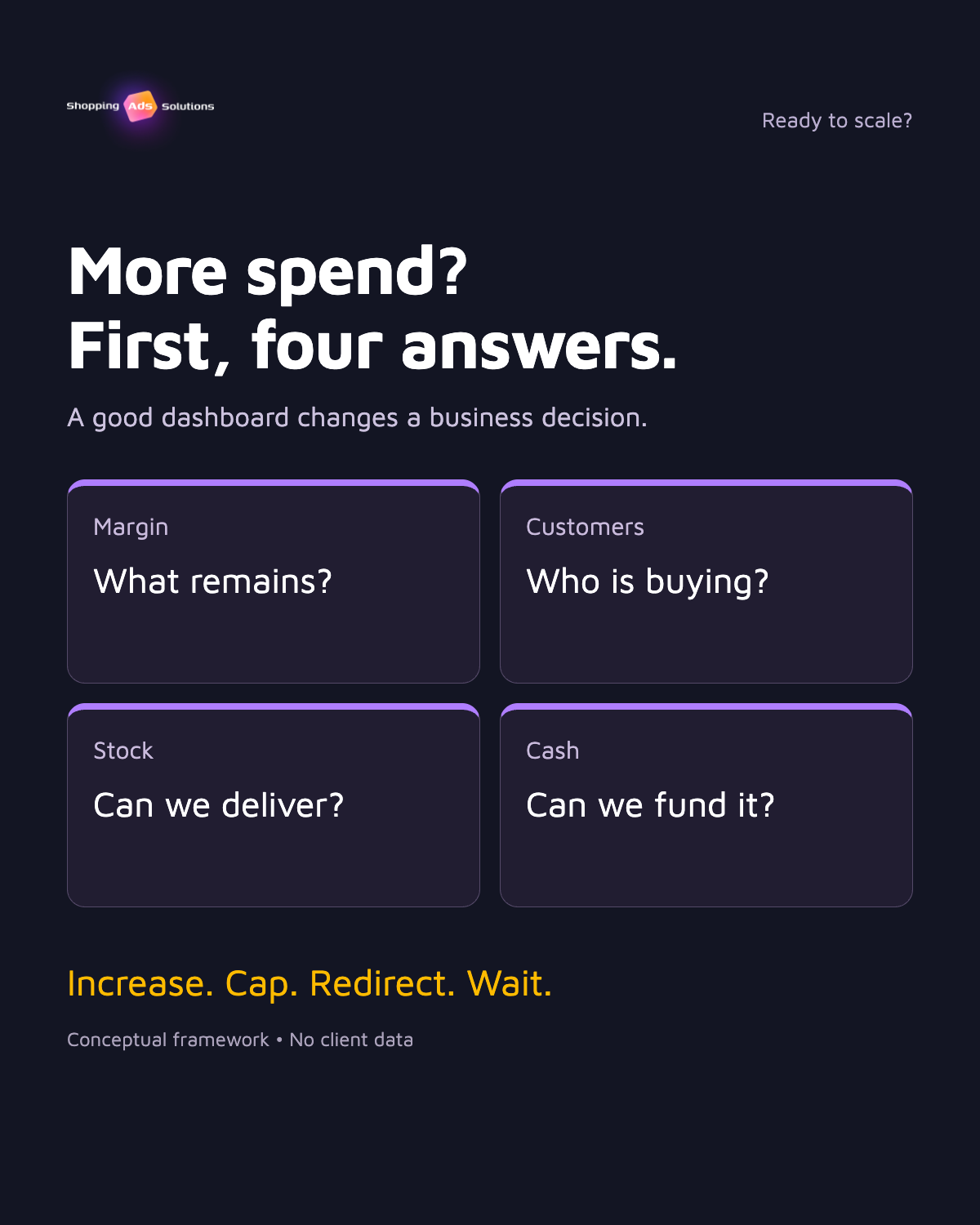
At Shopping Ads Solutions, our standard is that the dashboard should help choose an action: increase, cap, redirect or wait. Each view earns its place by answering something that could change that decision. This is a conceptual framework, not a client dashboard or a claim that any set of metrics guarantees profitable growth.
“Scale the account” is too broad to guide a useful report. Are you considering more spend behind a specific product group, entering a new market or increasing the number of first-time buyers? Each proposal changes what you need to inspect. A blended store average may describe the current business while concealing the part expected to carry the next investment.
Put the proposed action at the top of the conversation. Then identify the evidence that supports it, the constraint that could stop it and the condition that would make you reconsider. An increase should explain where the additional money goes and why. A hold should explain what needs to become known.
Margin: what remains from the orders you want more of?
Revenue can improve while the economics of the next order deteriorate. Product mix, discounting, refunds and delivery costs can change what remains available to fund acquisition. That is why we want the relevant order economics beside the channel result, with the cost boundaries made explicit.
Shopify’s sales-report definitions distinguish gross sales from net sales, which subtract discounts and sales reversals. Its profit-report documentation also explains that product and variant profit coverage depends on costs recorded when items were sold. These definitions tell you how to read those reports; they do not establish your complete business profit.
Our recommendation is to examine contribution for the products and orders the proposed increase is likely to generate. Here, contribution means net order revenue less product costs and the agreed variable order costs. State whether acquisition spend is already deducted, and avoid counting it twice. Keep fixed overhead and financing visible in the broader decision.
If costs are incomplete, show that limitation. A clean chart cannot repair a missing economic input.
Customers: who is carrying the current result?
A strong store total may depend heavily on people who already know the brand. That can be commercially valuable, but it leaves another question: does the proposed acquisition investment bring purchasing customers whose economics support it? Someone who joined your email list has not necessarily bought. Someone who bought before is not a first-time purchasing customer.
Shopify’s customer reports distinguish first-time and returning purchasers and support groups based on the first order. Our recommendation is to examine the relevant customer mix rather than treating all orders as interchangeable.
If the scale argument depends on repeat purchases, separate observed behavior from the forecast. Compare customer groups over equivalent time since their first purchase. The first-order contribution article develops that question further. Here, it belongs beside the budget decision rather than replacing it.
Stock: can shoppers buy what the budget is promoting?
Stock readiness concerns the product selection customers are being invited to purchase. A category can remain available while the sizes, variants or bundles central to the growth proposal become difficult to buy. The budget decision should reflect that distinction.
Consider sellable availability and replenishment timing for the products expected to receive more demand. Then ask what happens if the investment succeeds before replacement stock arrives. Can the store fulfil the resulting orders? Does shifting demand to an available alternative preserve the economics and the offer?
Our published inventory investigation illustrates why product availability belongs in an advertising conversation. It is useful evidence of the diagnostic approach, not a prediction for another store. The practical dashboard question is whether the growth plan and the current product offer still describe the same business.
Cash: can the business carry the growth?
Expected profit and available cash answer different questions. A budget increase can create commitments before the associated customer contribution arrives. Stock purchases, supplier terms, refunds and the expected time to recover acquisition cost all affect the room available to proceed.
Shopify’s documentation states that sales reports do not track payments moving between the store and its customers. Treating a sales total as spendable cash would therefore give that report a job it does not perform.
Our recommendation is to put the proposed investment beside the business’s actual cash commitments and a plausible recovery window. If the argument assumes customers will return later, ask whether the business can finance that wait under less favorable conditions.
This need not turn every campaign meeting into a finance review. It requires enough commercial context to avoid approving demand the business cannot afford to serve.
Give every report a clear job
Search visibility, website behavior, orders and business contribution are connected questions, but they are not the same observation. Google’s Search Console performance report describes search clicks and impressions. Google Analytics’ ecommerce purchases documentation explains that ecommerce activity depends on events being sent from the site or app.
These tools can help identify where to investigate. Their reporting should not silently stand in for reconciled customer economics, available inventory or cash. More discovery may justify looking at a landing page. It does not, by itself, justify a larger acquisition budget.
Use matched periods, relevant product or customer segments and clear definitions when combining views. If a tracking change, promotion or stock disruption makes the comparison weaker, say so. Unknown is a useful status when it identifies the answer still needed.
End with an action the business can defend
Increase when the evidence and operating capacity support the proposed investment, with explicit review conditions. Cap when the opportunity is promising but the uncertainty needs a boundary. Redirect when a different product, offer or customer path has a stronger case. Wait when a missing answer could materially change the decision.
These are recommendations for disciplined judgment, not automatic rules or universal performance thresholds. The useful conclusion explains why the selected action fits this business now.
Before your next budget conversation, identify the one missing answer most likely to change the recommendation. If your reports describe activity but leave that decision unresolved, explore our Google Ads and Shopping work. Bring the question behind the budget increase alongside the campaign report.
Discuss the decision behind your next budget increase