

1 October 2026
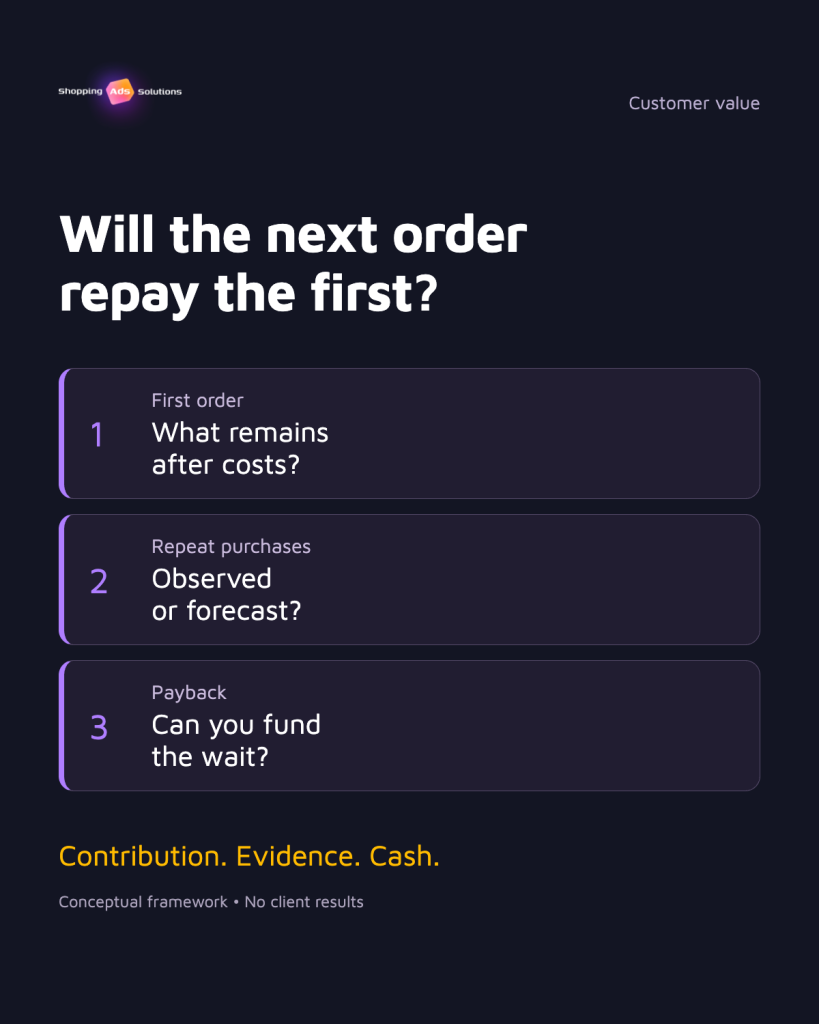
The first order is losing money. Someone suggests that this is acceptable because customers will buy again. That might be the right argument. It might also be an expensive assumption. For an established eCommerce business, the useful question is whether it can afford to acquire more customers under conditions it can actually support. Our decision standard connects what customers have contributed, what we reasonably expect next, and how long the business can carry the investment. This is a decision framework, not a client case or a promise that accepting losses produces profitable growth.
Identify what is losing money
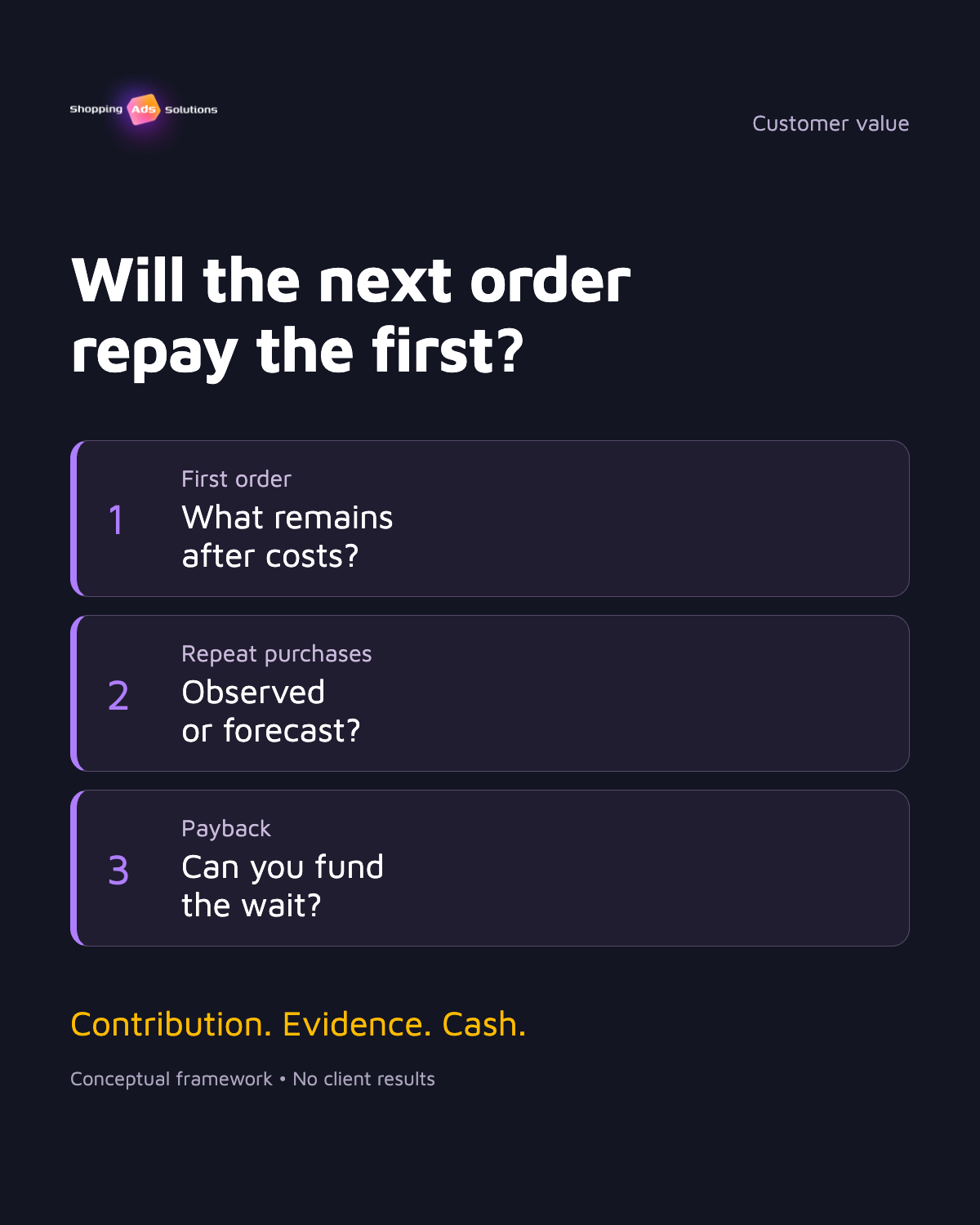
An order might cover the product, fulfilment and other agreed variable costs, but leave too little to recover acquisition spend. Alternatively, it might fail to cover those variable costs even before advertising. These situations need different responses: later purchases may recover an acquisition investment; more orders with negative contribution can add losses unless the economics change.
Separate first-order contribution before acquisition, the defined cost of acquiring a new purchasing customer, and contribution after acquisition. Contribution is net order revenue less product and agreed variable costs. It is not net business profit: fixed overhead, financing and other obligations still matter. If advertising has already been subtracted, do not subtract it twice.
Shopify’s profit-report documentation illustrates why boundaries matter: product gross profit uses recorded product costs, and missing costs affect coverage. Interpret a platform report within its calculation scope rather than treating it as fully reconciled business profit.
Revenue is not the budget available to acquire a customer
Ask what customer “value” contains. Historical revenue, predicted revenue and contribution after future order costs are different numbers. The customers acquired by the next budget increase may also differ from the historical average.
Shopify’s basic CLV explanation describes a revenue calculation. That can help explain purchase behavior. Our recommendation for financing acquisition loss is to use contribution with explicit cost boundaries. A repeat purchase still requires a product and delivery; a retention offer may require a discount or additional communication. Its value comes from what remains, not simply from its occurrence.
Keep observed value separate from the forecast
Historical performance describes a defined group. A forecast estimates what may happen later. Both can inform a decision; neither should silently become the other.
Group customers by first-purchase period and compare repeat behavior and contribution over equivalent elapsed periods. Older customers have had more time to return. They cannot establish what newly acquired customers have already achieved. Shopify’s customer-report documentation distinguishes first-purchase cohorts from future spending projections and warns that actual sales may differ.
Our business implication: the forecast should identify the assumption being financed. A different offer, market, product mix or acquisition source can change whether historical behavior applies.
Payback is also a cash decision
Here, acquisition payback means the time required for cumulative contribution, before deducting acquisition spend, to recover acquisition cost. Include relevant variable retention costs in the contribution calculation. There is no universal acceptable payback period.
A business replenishing inventory and paying suppliers can face a different cash constraint from another with the same expected customer contribution. Plausible eventual recovery does not prove that the business can finance the wait. New acquisition cohorts can commit more cash before earlier ones have paid back.
If customers return later or contribute less than expected, can the business keep operating without relying on the optimistic forecast? Lifetime value alone does not answer that question.
Explain the first-order loss before scaling it
Acquisition cost may have risen. An introductory discount may be deeper. Products, customers or returns may have changed. A healthy blended result may depend on existing customers. Our traffic-quality investigation shows why order and customer mix can change the next advertising question; it does not establish payback for your business.
If a fulfilment problem causes refunds, the next action may belong in operations. If the offer attracts one-time bargain buyers, investigate the offer or audience. Campaign changes become more useful when they address an identified commercial constraint.
Make a bounded decision
Comparable cohorts, measured contribution and affordable cash requirements can support controlled expansion. Promising but immature evidence calls for an explicit investment limit and review conditions. Missing contribution data, unsupported repeat assumptions or inadequate cash capacity call for repairing the economics before scaling.
Define what would change the decision: contribution, repeat behavior, returns, payback or available cash. Platform ROAS alone leaves much of that question unanswered.
Acquisition and retention belong in one commercial model. That does not make every loss strategic. Before spending more, explain what is observed, what is forecast, which costs are included and how you will finance the time between them.
If your team is debating future customer value, explore how our Google Ads and Shopping work or Meta Ads work connects acquisition to business economics. Bring the decision you need to make alongside the campaign report.
Discuss your customer acquisition economics