
The greatest value of intelligent automation is not replacing an eCommerce growth team. It is helping skilled people inspect more evidence, form better hypotheses, and prepare more high-value work—while humans remain responsible for the decisions.
Automation itself is not new. Marketing teams have used rules, scripts, scheduled reports, alerts, and data imports for years. Those systems are useful because they execute predefined instructions consistently.
What has changed is the kind of work an automated system can prepare.
An AI-enabled workflow can organize unstructured inputs, compare many observations, identify possible patterns, and generate a structured recommendation or draft for review. It can help a specialist move from a large volume of scattered evidence to a smaller number of decisions worth investigating.
That does not make the system infallible. It makes the system useful—provided that its evidence, limitations, and human approval are designed into the workflow.
This is the idea behind the first working version of the internal performance and creative-intelligence system we are building through Shopping Ads Solutions Labs.
The goal is multiplication, not merely replacement
The obvious financial argument for automation is reducing labor. Sometimes that matters. It is not the most valuable outcome we see.
The more important opportunity is increasing the capacity of the people already responsible for growth.
An experienced strategist may know which competitor pages to inspect, which offer differences matter, which creative attributes deserve comparison, and which conclusions would be premature. The constraint is often the volume and fragmentation of the evidence. Collecting, structuring, comparing, and documenting it can consume the time that the specialist should spend on judgment.
Intelligent automation can take on part of that preparation. The specialist still decides whether the evidence is relevant, whether an inference is reasonable, whether a concept fits the brand, and whether a proposed test is worth budget.
That distinction is essential:
| Rule-based automation | Intelligent automation | Human responsibility |
|---|---|---|
| Executes a predefined instruction | Organizes evidence and prepares candidate interpretations or work | Reviews the evidence, rejects weak reasoning, approves the action, and owns the result |
| Produces the same defined output from the same condition | Can work across less-structured inputs | Defines commercial context and limitations |
| Reduces repetitive execution | Expands analytical and production capacity | Decides what should be tested or changed |
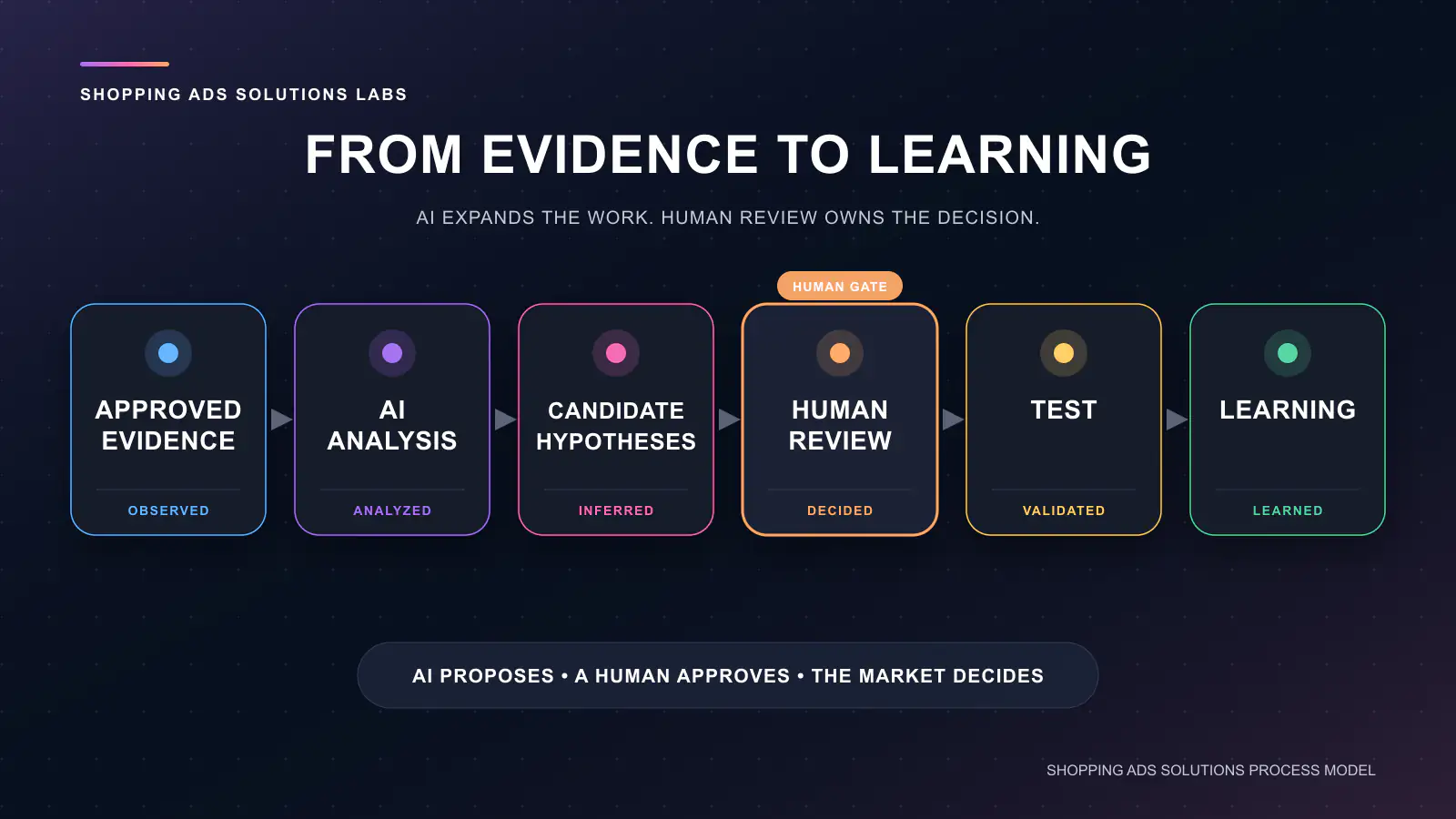
We are not trying to remove the specialist from the system. We are trying to give the specialist a stronger system.
What version one does today
The first version is already used inside our team. It is not a public self-service product, and it does not make unsupervised changes to client accounts.
Its current value appears in several connected workflows.
1. Turning competitor observations into concepts and angles
A competitor may run several products, offers, messages, landing pages, and creative formats across different channels. Looking at one ad rarely tells us much. The useful patterns emerge when observations are collected across multiple competitors and compared with the client's product, customer profiles, positioning, and existing strategy.
Our workflow helps structure that information and prepare multiple concepts and angles for review. It can compare recurring promises, pains, motivations, proof, objections, offers, awareness levels, and creative approaches.
The output is not a command to imitate a competitor. It is a map of what the market appears to emphasize, what it may be neglecting, and which differentiated hypotheses deserve the team's attention.
The strategist reviews every suggestion. Some are approved, some are edited, and some are rejected. That review is not a failure of the automation; it is part of its design.
2. Finding keyword opportunities before paying to learn everything through live traffic
Google's Auction Insights report compares an advertiser with others participating in the same auctions. That is useful, but it is necessarily based on auctions in which the advertiser was eligible to participate. It is not a complete view of every keyword a competitor may target. Google describes Auction Insights in those shared-auction terms.
Our current keyword-research workflow approaches the question from another direction. Google's KeywordPlanIdeaService can generate keyword ideas and historical metrics from keyword seeds, a page URL, or both. Google documents those inputs explicitly.
That means we can use a relevant competitor or category page as one input when exploring the language and demand surrounding an offer. We can then compare the returned opportunities with the client's current coverage and decide which gaps deserve validation.
This does not reveal the competitor's private keyword list or bids. It gives us evidence-based keyword opportunities before requiring the client to spend money on every possibility simply to discover that it exists.
The result is a better starting hypothesis—not secret access to another advertiser's account.
3. Finding patterns in stronger and weaker creative
Creative analysis becomes more valuable when visual and messaging attributes are placed beside an explicit performance basis.
For a client's own authorized data, the team can compare creatives using a defined metric and period, then examine attributes such as background, product framing, close-up versus wider composition, visible people, offer treatment, on-image copy, hook, angle, and format.
The system helps organize those comparisons and suggest possible explanations. For example, it may notice that a group of stronger-CTR static images uses closer product framing and less background detail.
That still does not prove the framing caused the CTR difference. Product selection, audience, placement, offer, seasonality, and delivery can all affect the result. The output is a hypothesis for the next controlled comparison.
The same operating principle appears in our analysis of how missing priority sizes change whether a fashion product should remain eligible for Google Shopping spend. In both cases, the platform signal becomes useful only when it is connected to the commercial probability behind the click.
Competitor ads require an even stricter limitation. Public sources can show what was observed, how often it appeared, and how long it remained visible. They usually cannot prove profitability. We can analyze the competitor's apparent strategy; we cannot label an ad successful merely because it exists.
4. Preparing creative work for human approval
Once the product, ICP, concept, angle, placement, offer, and relevant evidence are connected, the system can prepare placement copy and a creative brief.
The team does not begin with an empty page, and the brief does not begin with a generic request to “make more ads.” It begins with an approved strategic chain and preserves the restrictions and evidence that matter.
A human then reviews, edits, approves, or rejects the result before it moves into production.
This is where intelligent automation becomes operational rather than decorative. It does not merely generate text. It carries approved context from research into the next piece of work.
“Understanding why” really means forming a better hypothesis
One of the most tempting mistakes in analysis is moving too quickly from a pattern to a cause.
If a group of ads has a stronger CTR, the system can identify what those ads have in common and what differs from weaker ads. It can propose explanations. It can rank which explanation appears most consistent with the evidence.
But “why” becomes decision-grade only after the team considers competing explanations and tests the one that matters.
Our standard is therefore not: the AI found the answer.
It is: the system reduced a large field of observations into a smaller set of evidence-backed hypotheses that a specialist can evaluate and test.
That is less dramatic. It is also much more useful.
What has changed for our team
Building the first version required meaningful work. We had to map the workflows, define the inputs, separate observed evidence from inference, define output structures, add validation rules, and decide where human approval was mandatory.
Now that the first version is in daily use, we see a clear operational improvement: team members can prepare more work, with greater completeness and consistency, than when every collection and structuring step had to be repeated manually.
We are deliberately not publishing a productivity percentage yet. We have not supplied a controlled before-and-after time study, edit-rate benchmark, or universal quality score, and we do not want a directional internal observation to look like an industry result.
The next measurement layer should make the improvement more explicit: time from evidence to reviewed brief, percentage of generated work approved versus materially rewritten, coverage of the original evidence, number of useful hypotheses produced, and whether the resulting tests improve the commercial decision.
The advantage is not “more AI.” It is a better operating system
AI does not remove the need to understand the business. It increases the importance of defining the right objective, supplying credible evidence, protecting client data, and deciding which actions require human control.
For an established eCommerce brand, the problem is rarely a total absence of data. The problem is that product, customer, competitor, keyword, creative, inventory, and advertising evidence live in different places and move at different speeds.
The opportunity is to connect that evidence into a repeatable decision system:
Collect → structure → compare → form hypotheses → review → test → learn.
That baseline-first logic also shapes our first 30 days with an eCommerce brand: establish what the evidence can support, then decide what to protect, stop, fix, and test.
That is what we mean by intelligent automation. It is not an autonomous replacement for the growth team. It is an internal co-pilot that helps the team do more of the work that requires judgment—and spend less of its capacity preparing the evidence for that judgment.
Want us to inspect where your growth process is losing decision quality?
Shopping Ads Solutions' paid growth audit examines advertising alongside the commercial evidence it is meant to produce. We look for the constraint that is making acquisition decisions slower, less reliable, or less profitable—and identify what should be protected, stopped, fixed, or tested next.
Request a paid growth audit. If we subsequently work together, the audit fee is credited against the agreed engagement.
Method and limitations: This article is a first-party account of Shopping Ads Solutions' internal workflow, based on Michael Chachashvili's August 10, 2026 founder interview and a review of the current internal implementation. It is not an independent productivity study. No private competitor bids or keyword lists are accessed. Keyword ideas derived from public pages are opportunities, not proof of competitor targeting. Creative explanations are hypotheses until tested. No client data or client-identifying artifact is included.
About the author: Michael Chachashvili is a co-founder of Shopping Ads Solutions and works across acquisition, measurement, creative systems, and profitable eCommerce growth. Published August 10, 2026.