
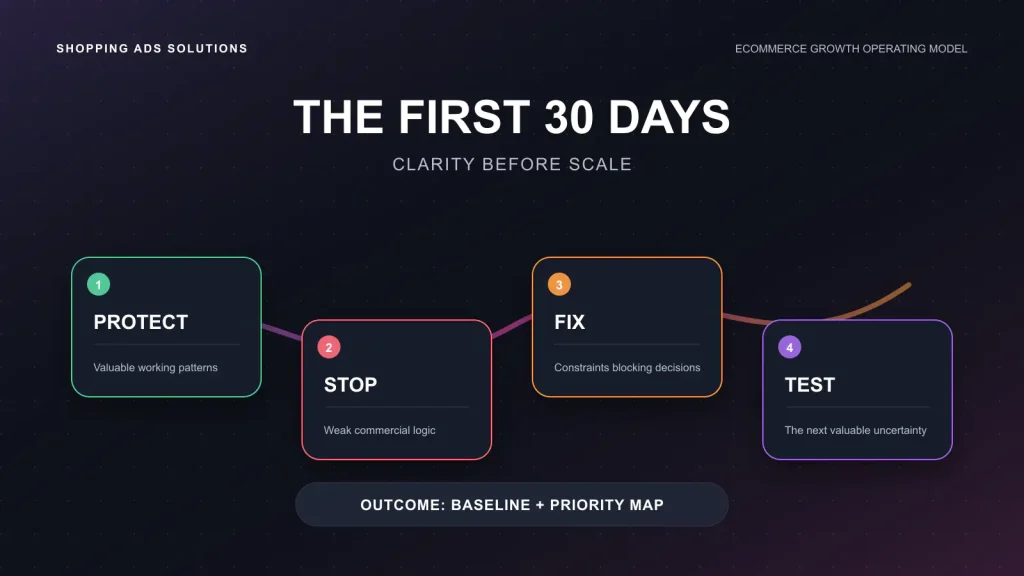
The most useful result of the first 30 days with an eCommerce agency is not a long list of campaign edits. It is a reliable commercial and measurement baseline, followed by a priority map showing what to protect, stop, fix, and test—and why.
That may sound less dramatic than rebuilding an account on day one. It is also far more useful.
A campaign can look inefficient because the traffic is weak. It can also look inefficient because the best-selling size is unavailable, the offer is no longer competitive, returning customers are being counted as new acquisition, the website is creating friction, or the reporting does not reflect the outcome the business actually values. Changing bids before separating those possibilities can create activity without creating clarity.
Our first month is designed to avoid that mistake.
Before day one: can the data support the engagement?
At Shopping Ads Solutions, the 30-day period does not begin when the first access invitation arrives.
Before paid services start, we perform a narrow validation of tracking and reporting readiness. The purpose is to establish whether the available systems are usable enough to begin responsible work and to identify any prerequisite that would make the starting point misleading. Once that validation is complete, written confirmation establishes the Service Commencement Date. That is day one.
This validation is not a free version of our paid growth audit. It does not diagnose the whole acquisition system or deliver the brand’s growth plan. It answers a narrower question: can we begin the engagement with a sufficiently credible view of what is happening?
The time required before commencement can vary. Access, data quality, platform configuration, technical constraints, and the client’s response time all matter. We would rather define the starting line honestly than pretend the first month began while essential evidence was still unavailable.
The first 30 days are a connected investigation
The work below is presented in seven parts, but it is not a rigid seven-step calendar. Several parts overlap, and their depth depends on the brand, the available evidence, and the agreed scope.
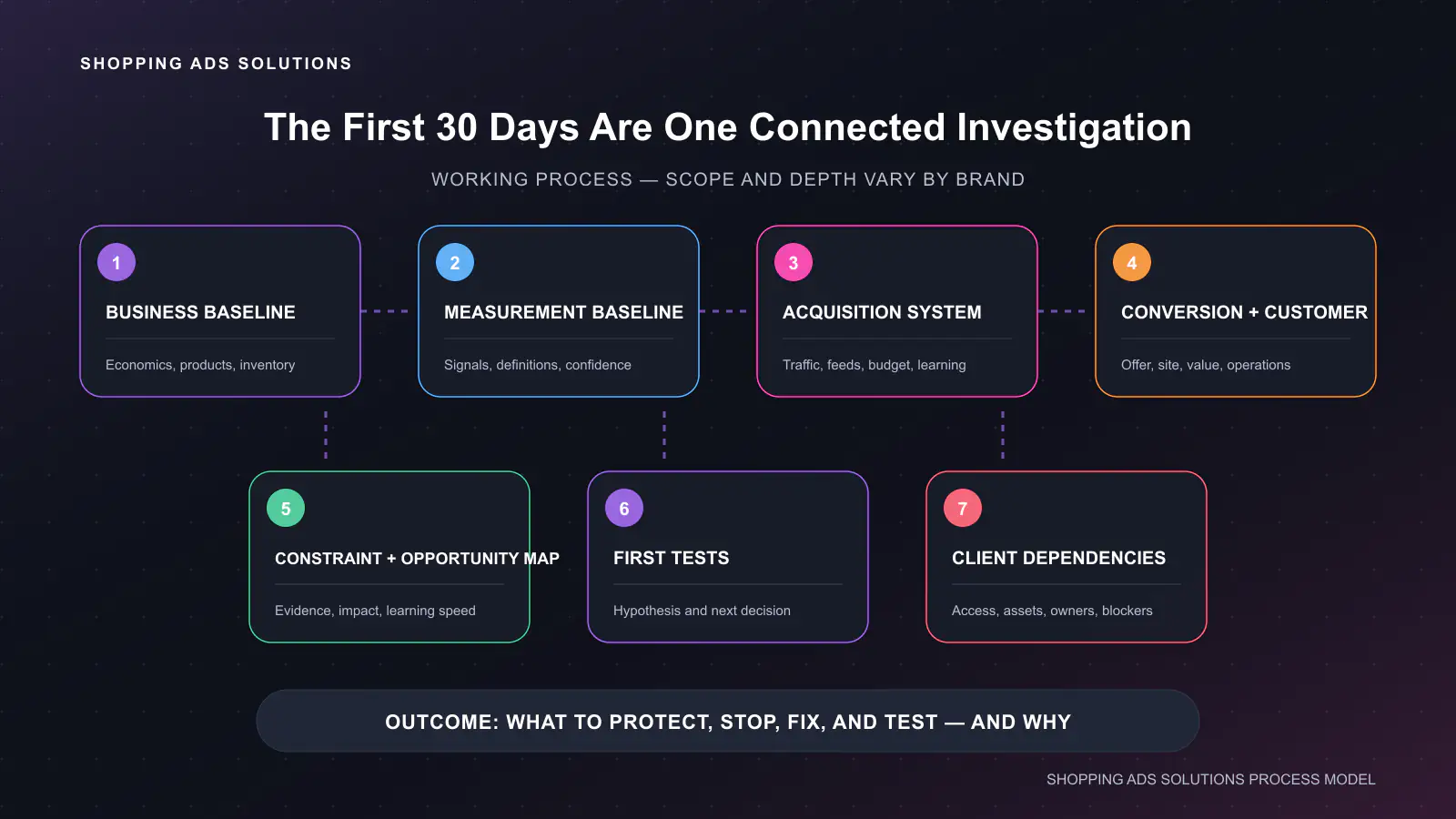
1. Establish the business baseline
We first need to understand how the brand makes money—not merely how the ad account reports revenue.
That can include the revenue model, margin structure, new-versus-returning customer mix, target acquisition economics, product and category contribution, inventory depth, markets, promotions, seasonality, discount dependence, and operational constraints.
This matters because the same platform ROAS can describe very different businesses. One account may be acquiring valuable new customers at an acceptable first-order margin. Another may be collecting purchases from existing customers who would have returned anyway. A third may be shifting spend toward products that generate revenue but little useful contribution.
We documented one example of this wider problem in More Google Ads Spend, Less Revenue: campaign metrics cannot explain the commercial result when they are separated from orders, customer mix, discounts, and product economics.
The baseline does not need to make every number perfect. It needs to expose which numbers are decision-grade, which are directional, and which remain unknown.
2. Establish the measurement baseline
Next, we compare what the business believes happened with what the measurement systems recorded.
We examine the events and values used for optimization, the definitions behind reported revenue and customer acquisition, attribution differences, missing signals, duplicated signals, and the path from an ad interaction to a business outcome.
The objective is not to declare one dashboard universally correct. It is to understand what each source can and cannot support. If a reported conversion does not represent the same thing as a commercially meaningful result, the campaign may optimize successfully toward the wrong target.
Some tracking gaps require repair before a test can be interpreted. Others can be documented as limitations while work continues. The important point is that uncertainty becomes explicit instead of being hidden inside a precise-looking report.
3. Examine the acquisition system, not just campaign settings
Only then can we interpret the paid media account in its proper context.
Depending on the channel and available data, we may examine traffic quality, search terms, audience and geographic patterns, product-feed eligibility, product and category allocation, creative learning, budget distribution, campaign structure, prior experiments, and the relationship between prospecting and returning demand.
We are not looking for changes simply because a setting can be changed. We are looking for the current logic of the customer-acquisition system: where the budget is being directed, what probability it is buying, what the platform appears to be learning, and whether that learning supports the brand’s economic objective.
In one US swimwear analysis, removing designs after their major sizes went out of stock changed which inventory remained eligible for advertising. The relevant issue was not merely a bid or campaign structure. It was the commercial probability behind each paid click. The full reasoning is documented in What Happened When We Stopped Advertising Fashion Products With Their Most Important Sizes Out of Stock.
4. Examine the conversion and customer system
Paid traffic cannot compensate indefinitely for every weakness after the click.
We therefore inspect the parts of the commercial system that can change the value of that traffic: offer clarity, price and promotion, merchandising, trust, product pages, checkout friction, creative-message continuity, inventory, fulfilment constraints, repeat-purchase behavior, and customer value where reliable evidence exists.
This does not mean every CRO, retention, feed, creative, development, or operational task is automatically included in the engagement. Diagnosis and implementation are different commitments. Some work falls within our scope, some is separately scoped, and some remains a client dependency.
But the distinction between “media problem” and “business-system problem” must be made before more budget is used as the answer.
5. Build the constraint and opportunity map
By this point, we usually have more possible work than should be done at once. The next job is prioritization.
We organize the findings around five questions:
- How strong is the evidence?
- How large could the commercial impact be?
- How quickly can the business learn from the action?
- How reversible is the decision if the hypothesis is wrong?
- Which access, assets, approvals, technical work, or client actions must happen first?
This is where observations become a decision system. A suspicious campaign may deserve protection while a measurement issue is resolved. A high-spend product group may need to be stopped or constrained. A strong offer may deserve more controlled exposure. A website, inventory, or creative dependency may need to be fixed before a media test can answer anything useful.
The map prevents urgency from becoming randomness.
6. Choose the first tests—and define what they should teach us
The first tests should address the most commercially important uncertainty that the available evidence can actually resolve.
For each one, we want a clear hypothesis, the reason it was prioritized, the change being made, the evidence we expect to inspect, and the next decision that each plausible result would support. That may involve the account, feed, offer, audience, creative, landing experience, or a combination of systems.
We do not promise that every constraint will be fixed in 30 days. Nor do we force a conclusion before the brand has produced enough useful evidence. Volume, seasonality, inventory movement, implementation speed, and creative production can all affect how quickly a test becomes interpretable.
The first month should make the testing sequence more intelligent, not make the uncertainty disappear on schedule.
7. Make client dependencies visible
Agency work does not happen independently of the business.
Access can arrive late. A promotion can change. Inventory can weaken. A landing-page update can wait for development. New creative can require production. A merchandising decision can change the products available to scale.
We record those dependencies because they affect both timing and interpretation. During the first two months, our normal cadence includes weekly calls so that findings, decisions, owners, and blockers remain visible. The purpose is not to fill a meeting calendar. It is to keep the operating system synchronized while the baseline is being established and the first tests are running.
What the brand should have at the end of the month
By the end of the first 30 days, the useful deliverable is a baseline and a ranked priority map.
It should make four categories clear:
Protect: profitable or strategically important patterns that should not be disrupted without a reason. Stop: spend, activity, or assumptions for which the current commercial case is too weak. Fix: measurement, offer, feed, website, inventory, creative, or operating constraints that are blocking better decisions. Test: the highest-value uncertainties that can be examined with a defined hypothesis and next decision.
Not every item will have been implemented. Not every test will have reached a verdict. The value is that the client and agency are no longer reacting to isolated platform signals without a common commercial model.
That is also why there is no honest fixed timeline for profitable advertising. Thirty days can define the baseline, priorities, and first learning cycle. It cannot guarantee the amount of evidence, inventory, implementation speed, or market response needed for every brand to reach the same outcome.
The standard is clarity before scale
We do expect action in the first month. We simply do not confuse the number of actions with the quality of the work.
The purpose of the first 30 days is to connect advertising to the business it is meant to grow, make the most expensive uncertainties visible, and direct the next unit of time and budget toward the strongest available commercial probability.
That is the baseline we want before scale.
Related process: The same baseline-to-hypothesis discipline is why we are building intelligent automation for eCommerce growth teams: to organize dispersed competitor, keyword, and creative evidence for human review before it becomes a test or budget decision.
Want us to examine your current growth system?
Shopping Ads Solutions’ paid growth audit examines advertising alongside the commercial evidence it is meant to produce. The purpose is to identify the strongest current constraint and determine what should be protected, stopped, fixed, or tested next—not to hand over a generic checklist.
Request the paid growth audit. If we subsequently work together, the audit fee is credited toward the agreed contract.
Method note — prepared August 7, 2026: This article describes Shopping Ads Solutions’ current first-month working process, confirmed by Michael Chachashvili on August 7, 2026 and supported by the agency’s operating model and reusable service agreement. It is a first-party process account, not an industry benchmark or performance study. The exact sequence, evidence available, responsibilities, and implementation scope vary by engagement. No revenue, ROAS, CAC, or profitability result is promised within 30 days.
About the author: Michael Chachashvili is a founder of Shopping Ads Solutions and works on paid acquisition, measurement, and profitable growth systems for eCommerce and service businesses. Published August 7, 2026.