

By Michael Chachashvili
Shopping Ads Solutions · 5 October 2026
After years of working in and serving ecommerce businesses, I keep coming back to the same realization: progress depends on what a business remembers.
What did we try? Why did we try it? What happened? And did that experience change the next decision?
There may be plenty of data and capable people. But the reasoning behind a campaign sits in one conversation, a recurring complaint sits with customer support, and the explanation for a returned product never reaches the next creative brief. When those connections are lost, the business can end up paying to learn the same lesson again.
What I want to build is a useful business memory: a way to connect data, experience, customer understanding and results so each decision can benefit from the work that came before it.
Growth still has to pay its way
More sales can be encouraging. Whether they support the business depends on what it costs to earn and serve them.
Advertising, the product itself, shipping, discounts, returns, support and other relevant expenses belong in that judgment. Be clear about which costs have already been deducted, and keep broader overhead and cash commitments visible. Otherwise, it is easy to count a cost twice or mistake an incomplete margin for profit.
Future repeat purchases can change the economics, but that argument needs evidence. What have comparable customers actually bought, over what period, and at what cost? An expected future order should not quietly become an observed one.
A business memory needs that commercial foundation. It should help us ask whether an action improved the business, as well as whether a campaign number improved. Our dashboard-readiness article explores the financial and operating questions behind a budget increase. Here, the question is how the business keeps and uses what those decisions teach it.
Follow the customer experience across the business
A sale tells us that somebody bought. A return may tell us that the experience did not meet an expectation. A support conversation can help explain where that expectation began.
I want to connect those observations with customer reviews, advertising performance and related advertising data, comments on ads wherever they appear, organic activity, influencer blogs and videos and their comments, and relevant public competitor information.
Each source describes a different part of the experience. Together, they give us better questions to investigate.
That does not mean pretending every record describes the same person. Connect individual records only when there is a reliable, permitted match. Otherwise, connect the themes. Someone commenting on a video may be a customer, a potential customer or simply interested in the subject. Their comment is useful without assigning them a purchase history we cannot establish.
For customer support, I would look beyond the complaint category. What did the person see? What did they expect? What actually happened? Where did the gap begin?
Those answers can lead to a better product or service, a clearer promise, or both. Positive reviews matter too: they can show which benefits people value and which promises the business fulfilled. Negative reviews can reveal unmet expectations or recurring friction. Neither group should be treated as a complete picture of all customers.
A complaint can improve the next advertisement
Consider a hypothetical example, not a client case or a reported result.
An advertisement makes a product appear larger than it is. People buy expecting something bigger. Support requests and reviews describe disappointment, and some returns mention size.
These observations suggest an explanation: the presentation may be creating an expectation the product cannot fulfil. They do not establish that every complaint or return has the same cause.
The next action could be to show the actual dimensions more clearly, improve the scale reference in the images, and make sure the advertisement and product page describe the same item. Materially misleading information should be corrected promptly; it should not be kept live merely to create a comparison group.
We can then test whether the clearer presentation is associated with fewer relevant complaints and returns while profitable sales remain healthy. Define the periods and comparable product or order groups, allow time for purchases to become returns, and note other changes that could affect the comparison. A stronger causal claim would need a suitable experiment, not just a favorable before-and-after chart.
If sales fall, we need to understand why. Perhaps the clearer presentation filters out people whose expectations would not have been met. Perhaps it also makes the product harder to understand. The decision should consider customer experience and the resulting economics, rather than assuming that fewer complaints alone makes the change a success.
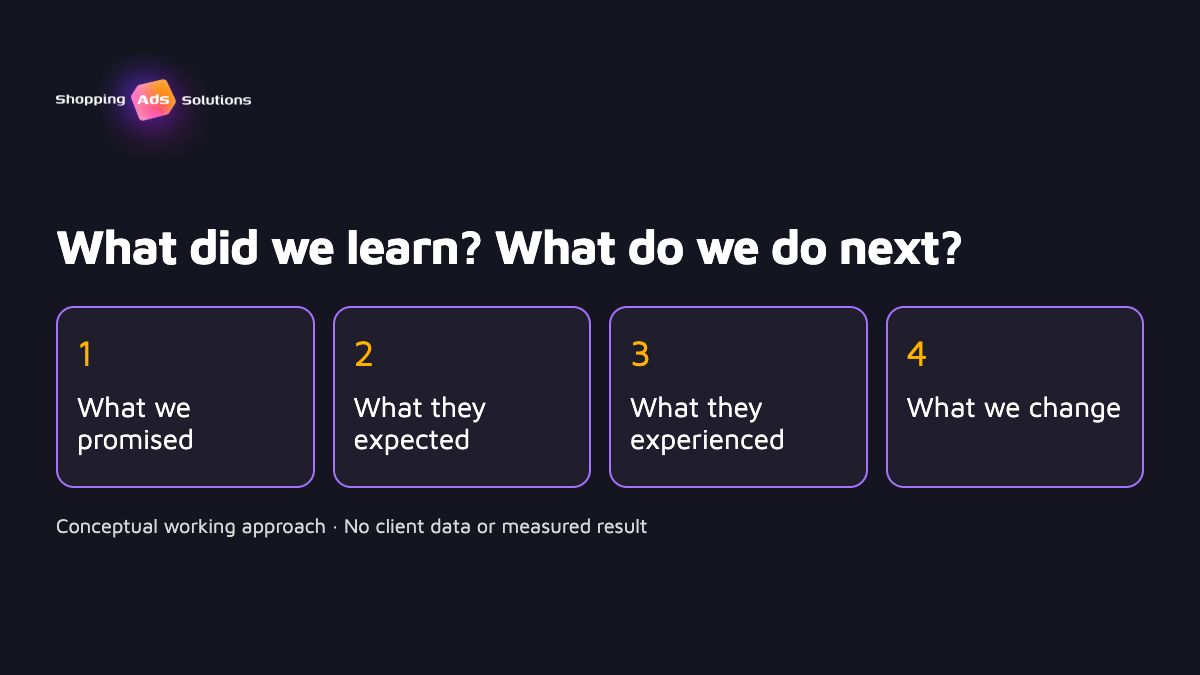
The useful connection is the whole sequence: what we showed → what people expected → what they experienced → what we changed → what happened next.
Keep the ingredients, the combination and the result
To recognize useful patterns, we need a consistent way to describe the work.
Attributes are the ingredients: the product, audience, message, offer, channel and customer experience. Connections show how those ingredients came together. Results tell us what happened afterward.
For the size example, simple tags might identify the product, the “looks larger” expectation, the advertisement, the clarification and the return reason. That makes the lesson easier to find when the next brief concerns a similar product.
The point is not to tag everything imaginable. Keep the descriptions consistent enough to retrieve information that could change a decision. Preserve the source and date so somebody can check what the observation actually supports.
Qualitative information belongs here too. A comment about a confusing image can help form a better question even when we cannot assign that comment a sales value. Forcing every observation into a revenue number can hide the part that made it useful.
A pattern is a reason to investigate
Seeing a similar message beside several strong results is interesting. It does not prove that the message caused them.
The product, price, audience, season, availability or traffic mix may have contributed. Preserve those conditions alongside the finding, together with the uncertainty and the confidence the evidence deserves.
Also check whether apparently separate observations are really repetitions of one event. A support complaint copied into a report and then quoted in a meeting is still one complaint. Counting it three times creates confidence the business has not earned.
I would distinguish what we observed, the explanation we proposed and what a test established. “Promising but inconclusive” is a useful conclusion when it guides the next investment.
The learning loop is:
Observe → form an explanation → test → measure → update our understanding → choose the next action.
It is a conceptual working approach, not a promise of measured improvement. Sometimes the next action is another test. Sometimes it is a correction, a closer investigation or leaving a useful test alone.
A failed idea also needs context. An offer that did not work with one audience in one season may be worth reconsidering under different conditions. Remembering the failure means retaining those conditions, rather than turning one result into a permanent rule.
Competitors help us ask better questions
Public competitor activity can reveal what another business offers, emphasizes or promises. Reviews and discussions can suggest needs worth exploring.
What we usually cannot see is the profitability behind those choices. A repeated advertisement is not proof of profitable acquisition. A recurring discount may support the business or erode its margin. A commenter is not automatically a confirmed customer.
Use that information as context: what question does it raise about our customers, and do we have evidence worth investigating in our own business?
Copying the visible action without understanding the economics can import a cost without importing a reason.
Organic growth and branding need time and accountability
The same memory should include organic activity and branding. Their contribution may emerge through relevant visibility, qualified visits, enquiries, trust or repeat purchasing over time.
Immediate sales cannot be the only measure. But “this takes time” is not a reason to avoid a decision indefinitely.
Before starting, define the intended role, production and maintenance costs, a suitable observation window and a review date. Decide what evidence would support continuing, improving, distributing differently or stopping. There is no universal waiting period that fits every business or activity.
A rise in branded searches or repeat purchasing may be worth investigating. It does not, on its own, establish which activity caused it. Keep the observations and the explanation separate, and account for other things happening during the period.
Repeat what holds up, and leave room to explore
A useful memory should make exploration easier, not lock the business into familiar ideas.
Repeat combinations with credible evidence behind them, while checking that the conditions still fit. Set aside room to investigate new products, messages and opportunities within limits the business can afford.
Our article on AI creative testing looks at what a team needs to produce and evaluate alternatives. Business memory gives that work a starting point: what do we already know, what remains uncertain and what would be valuable to learn next?
AI can assist with much of the execution, including organizing information and preparing alternatives. The useful question is how it acts on knowledge that is accurate, current and relevant. Faster execution based on a weak explanation can repeat a mistake faster.
Human relationships remain important where trust, negotiation, judgment and responsibility shape the outcome. A useful system should support those responsibilities, not make them disappear.
Why I am building Shopping Ads Solutions Labs
This is the purpose behind my work on Shopping Ads Solutions Labs: to help a business retain what it learns and bring that understanding into its next decision, whether the work is carried out by people or supported by AI.
That describes my purpose for building it. It is not a statement of verified current capabilities, integrations, autonomous operation, availability or results.
The starting point can be modest. Before your next campaign or product change, take one recurring customer question and trace it back to what the person saw, expected and experienced. Record your explanation, the change you intend to make, the costs that need protection and the evidence you will review afterward.
If your reports show activity but leave those connections unresolved, our ecommerce analytics and dashboards work is a place to start the conversation. Bring one decision your current reports cannot answer.
Your next investment should benefit from what your last investment taught you.
This article presents my experience and proposed working approach. The product-size example is hypothetical. It reports no client outcomes or measured improvements. AI assisted preparation; the recommendations require judgment and evidence in the business applying them.