By Michael Chachashvili, Shopping Ads Solutions
September 23, 2026
AI may make a wider range of advertising ideas practical for a small team to produce. Whether those ideas become useful tests is a different question. The business still needs a way to choose what to test, check the work, pay for the experiment, interpret the evidence, and decide what comes next.
That is the opportunity I find interesting: not producing the largest possible pile of ads, but exploring ideas that previously felt too expensive to try.
A post shared by Markus Repetschnig prompted this discussion. Its accompanying “Hooks menu” brings together 18 ways to open an ad. A hook is the opening that gives someone a reason to pay attention: a question, a problem, a demonstration, a surprising visual.
It is an appealing menu. But for a smaller eCommerce company, the missing question is operational: who is going to turn those possibilities into something the business can actually learn from?
A menu of possibilities, not a production quota
The image mixes messages, formats, and attention devices. A question is a message approach. A podcast is a format. Motion is a visual technique. Those choices can overlap within one ad; they are not necessarily separate ideas about why a customer would buy.
My reading is that the value lies in widening the team's options, not requiring every brand to use every hook.
A question and a product demonstration might both help explain a storage product. A dramatic destruction scene might add nothing useful. The relevant question is not “Have we tried everything?” It is “What do we need to understand about this customer and this product?”
Where AI can help
Some production tasks already have concrete AI-assisted options. Adobe documents expanding an existing image into a different frame and editing a selected image area with Generative Fill.
For a small team, that creates possibilities: explore a different setting, adapt a composition, or prepare an alternative visual without rebuilding the whole asset. Whether that saves time depends on how much review and correction the output needs. Tool access and generation costs also belong in the calculation.
I would start with real, permitted product material and use AI around it where the result can be checked. Product details, dimensions, packaging, demonstrations, and performance claims need particular care. An attractive image is not useful if it shows something the customer will not receive.
The distinction is simple: AI can help make alternatives. It cannot, by producing them, establish which alternative is better for the business.
The real workload starts before and continues after production
Someone still has to decide what each version is meant to test. Someone has to approve it, label it, connect it to the right campaign and destination, and make sense of the results.
This is where I would assess a company's capabilities before recommending more volume:
| Capability | The practical question |
|---|---|
| Clear ownership | Who approves the work, checks the results, and makes the next decision? |
| A useful record | Can we connect each ad version to its idea, spend, results, and next step? |
| Reliable measurement | Are we measuring the action we intended, with consistent definitions and known limitations? |
| Room to learn | Can the business afford enough observation to answer the question, within an agreed loss limit? |
| A review routine | When will someone review the evidence, and what would make them continue, revise, stop, or call it inconclusive? |
Infrastructure does not have to mean an expensive software stack. At a small scale, a consistent naming system, a shared test record, and a responsible owner may be a sensible starting point. As the workload grows, reporting and workflow automation may become more useful. The process should match the business, not the size of somebody else's testing programme.
What a smaller first round could look like
Consider a hypothetical online store selling reusable food containers. This is an illustration, not a SAS client case or a reported result.
Instead of producing every format in the menu, the team could explore one question: what makes the product's value easiest to understand?
- Problem opening: show a cupboard with mismatched containers and lids.
- Question opening: ask why finding the right lid always takes longer than expected.
- Solution opening: demonstrate the actual product's storage arrangement, using only features it genuinely has.
Keep the product, offer, destination, and later explanation consistent where practical. Use AI selectively for production support; check that generated changes do not alter the product or add an unsubstantiated promise.
These three openings are an example, not a universal recommended test size. The number of versions should follow the team's capacity and available evidence, not an arbitrary content target.
The team could keep one short record for each version: the question, what changed, approval owner, test conditions, budget limit, review date, observed results, and next decision. That record matters because the next brief should begin with what was learned, not another blank page.
Decide what would count as a useful answer
Before launch, decide what the test can actually tell you. A round of creative exploration is not automatically a controlled experiment proving why one version worked. If the decision requires causal evidence, choose an appropriate experiment rather than treating a simple performance comparison as proof. Meta's own creative-testing training distinguishes A/B testing from lift testing.
Attention measures can help explain an opening. For a sales-focused test, I would also want to understand purchase results and the relevant costs, with the limits of the available data made clear. A compelling opening that attracts attention but misrepresents the offer is not progress.
There is no single waiting period or spending threshold that belongs in every business's plan. Set those boundaries around the decision, the buying process, and what the company can afford to learn. A test may end without enough evidence to choose a winner. Record that honestly; waiting longer is not automatically the right answer.
Measure the work as well as the ads
Before calling an AI-assisted workflow more efficient, compare the full workload with your current approach. Count briefing, generation, selection, editing, approval, launch preparation, analysis, and rework, alongside tool costs and media spend.
Useful questions include: Did we reach usable options with less effort? Could we keep track of them? Did the round change a decision? Did we learn something that improved the next brief?
Those are questions to test internally, not savings or performance improvements established by this article.
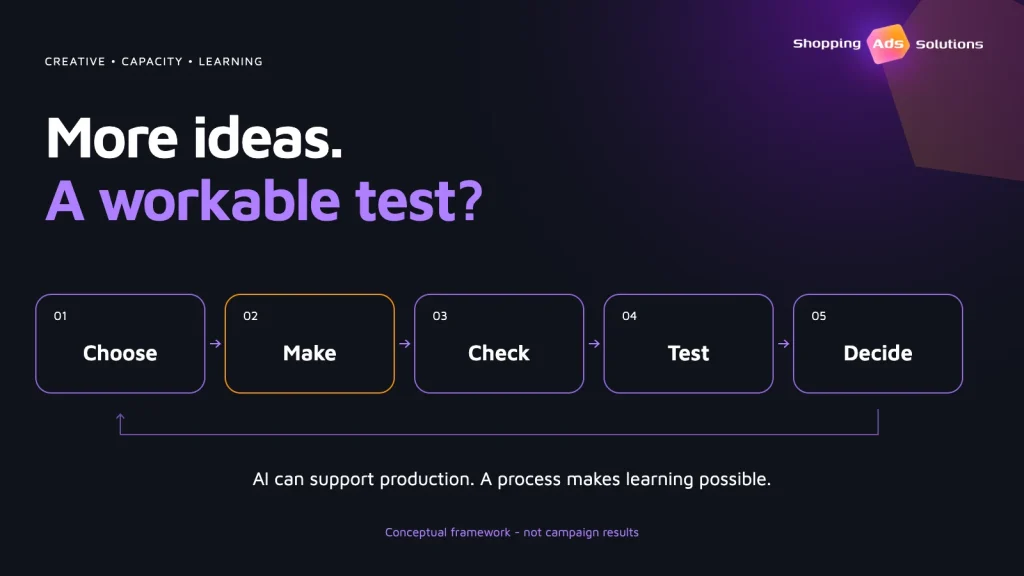
More production is an opportunity. A workable process makes it useful.
My view is that AI makes broader creative exploration worth considering for smaller businesses. But the promise is conditional: production support needs to fit the team's ability to check, test, interpret, and act.
For some companies, the next step will be better production tools. For others, it will be fewer simultaneous tests and a clearer owner. The goal is a manageable learning cycle, not a busy asset folder.
For a different perspective on where a creative tool fits, see our dated Pomelli review. It is a specific earlier product review, not evidence of current tool capabilities or proof of this proposed workflow.
At Shopping Ads Solutions, this is the business question we want our creative-development work to address: what can this team realistically produce, learn, and use? If that is the gap you are trying to close, let's discuss your creative-testing capacity.
Source note: Markus Repetschnig's post and the supplied hooks image inspired the question. We have not independently established that the image is an official Meta playbook. This article offers SAS's analysis, not a reproduction of that graphic or an endorsement by its author. It contains no measured client results. AI assisted preparation; the hypothetical example and recommendations are identified as such.