
16 October 2026
By the end of your first month with an eCommerce agency, you should be able to explain the next important business decision together: what needs attention, why it takes priority, what happens next and what evidence would change the plan.
That does not mean every tracking gap must be closed or every test must have produced a reliable result. It means the work should be making the business easier to understand and the next investment easier to judge.
A busy month can still leave the owner guessing
New access, account reviews, creative briefs, reports and meetings can all be necessary. Their value depends on what they help the team decide.
If the review ends with a long list of completed tasks, ask what those tasks have changed about the plan. Has the agency identified a constraint worth addressing? Has it ruled out a weak explanation? Has it exposed a dependency that someone on your team needs to resolve?
A useful answer connects the activity to a commercial question. For example: should the brand invest its next effort in acquiring more customers, improving the offer or removing a website problem?
The first month is a useful checkpoint for that conversation. It is not proof that the partnership has already produced profit.
Start with a baseline both sides can explain
The owner and agency need a shared understanding of the business they are trying to improve.
That includes the revenue definition being used, advertising costs, new and returning customers, product economics, stock availability and any cash or implementation constraints that affect the plan. The useful level of detail depends on the decision.
The baseline should also show what remains uncertain. If refunds have not been reconciled, a customer definition is incomplete or tracking changed during the comparison period, that limitation belongs beside the conclusion.
This need not become a project to perfect every number before doing useful work. A known checkout fault can deserve attention while a broader reporting question is still being resolved. The agency should explain which decisions the available evidence supports and which need more investigation.
Ask why this priority comes first
A list of possible improvements is easy to create. Choosing between them requires judgment.
Consider a hypothetical brand that wants more new customers. Its agency sees opportunities in creative, product availability and the website. The right first action cannot be selected simply by counting how many issues appear in each area.
Suppose products featured in a proposed campaign are unavailable. That makes stock availability relevant to the campaign decision. Suppose instead the concern is an unclear delivery promise on a product page. The team may need to investigate whether the offer is creating hesitation before producing more traffic.
Neither example establishes the diagnosis. Each shows the connection the review should make visible: the observation, the explanation being considered and the reason for the next action.
Ask the agency what it recommends protecting, changing or postponing—and what evidence could make another priority more important.
Give the next action an owner and a review trigger
A priority becomes useful when someone knows what to do with it.
Before the review ends, agree on the proposed action, who owns it, what needs to happen first and when the team will reconsider the decision. That review might follow a planned date, enough relevant observations or the resolution of a known dependency.
For a test, define the question and the signal before interpreting the outcome. If the signal is too weak to support a conclusion, the next review should say so. An inconclusive test can require more evidence, a different design or a decision to stop spending effort on that question.
This creates accountability on both sides. An agency recommendation may depend on product information, inventory plans, raw creative material or an implementation decision that only the merchant can supply.
Take these questions into your first review
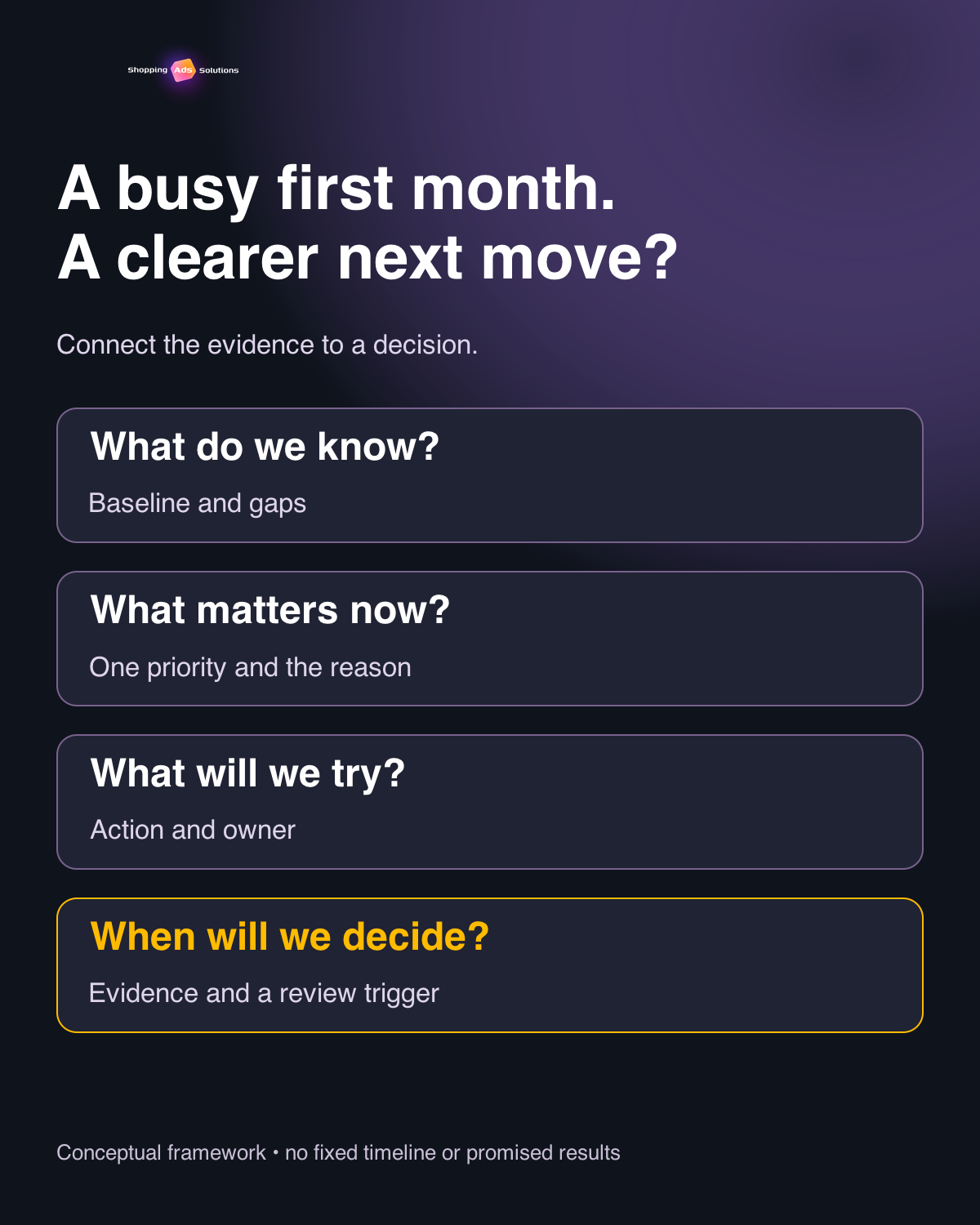
Use four questions to keep the discussion practical:
1. What do we know well enough to act on?
2. Which uncertainty or constraint deserves attention first?
3. What are we doing next, and who owns it?
4. What would cause us to continue, change direction or stop?
You do not need a polished answer to every question immediately. You do need a clear account of what is known, what is unresolved and how the next step will help.
At Shopping Ads Solutions, our recommended approach connects acquisition decisions with creative, the offer, the website, customer economics and measurement. The appropriate work and sequence depend on the business and agreed scope.
The same emphasis on useful business decisions informs the Labs tool we are developing. Labs remains in development; the framework here describes our thinking rather than a feature currently available to use.
Discuss your next growth decision