

Content updated: 25 October 2026
Customer complaints can justify immediate investigation without yet justifying a storewide change to the offer. For an established eCommerce business, the question is not whether to listen. It is which decision the available evidence supports, and how broadly that decision should apply.
Separate the warning from the size of the problem
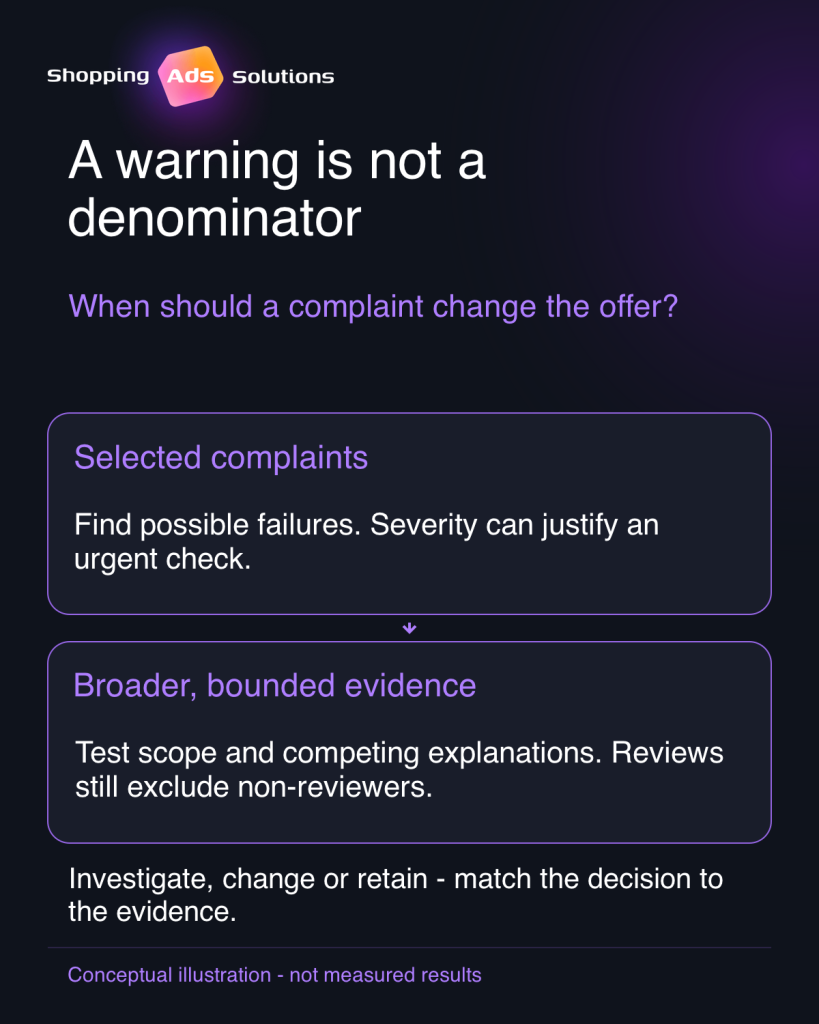
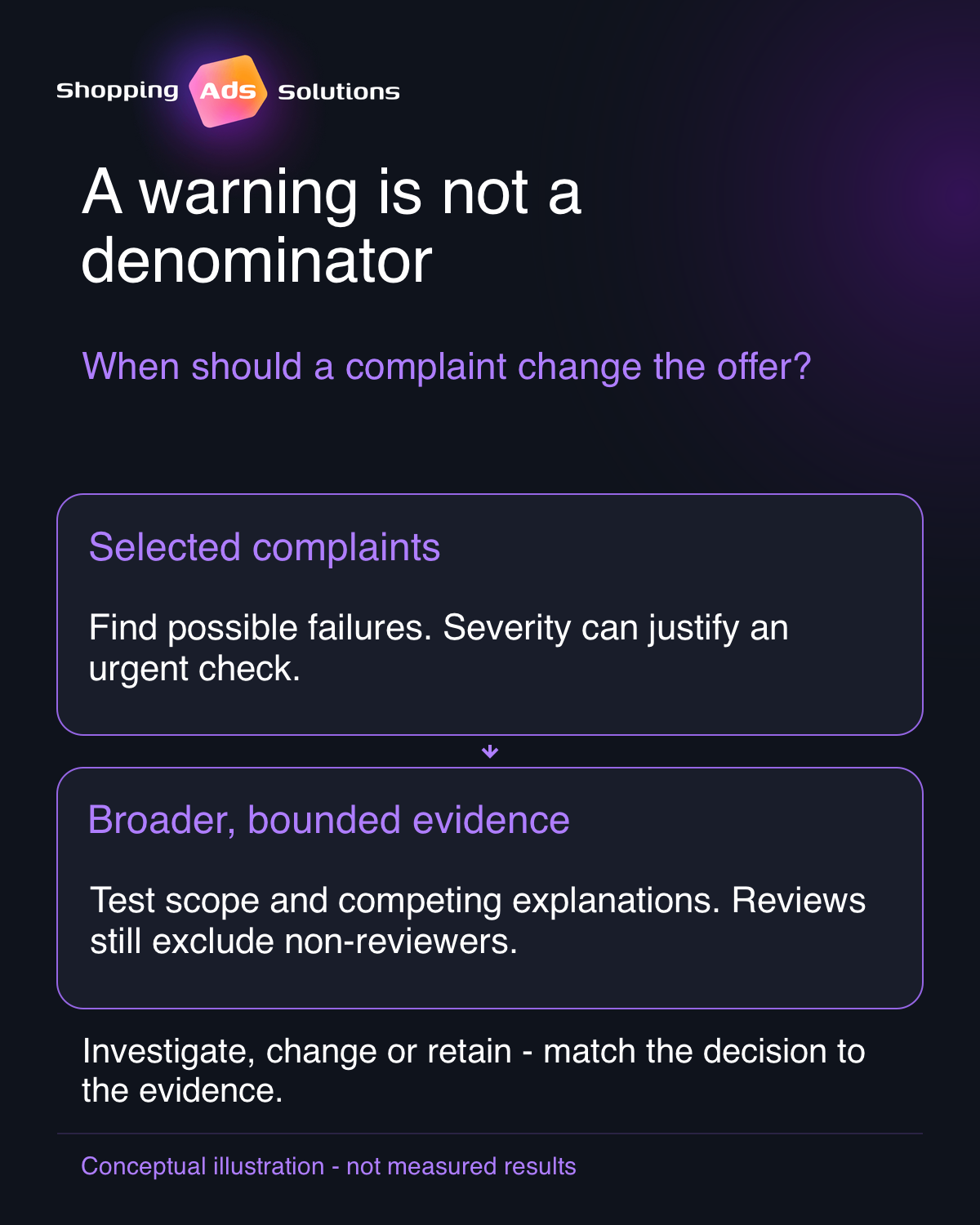
Our recommendation is to separate discovering a possible failure from judging how widely it occurs. A serious complaint may warrant an urgent operational check even when its frequency is unknown. But a deliberately selected collection of low-rated reviews cannot tell you what percentage of all customers experienced the problem.
A hypothetical delivery decision
Suppose an established store sees repeated late-arrival complaints in a selected low-rating set. Management is considering including expedited delivery in every order. This is a hypothetical decision, not a customer case or a finding from research we conducted.
The complaints identify something worth investigating. They do not establish whether the issue concerns dispatch, a delivery option, an unclear arrival promise or something else. Inspect the relevant order and service records before choosing a remedy. If those records establish a fulfillment failure, address that failure. If the advertised promise exceeds what the operation can support, investigate both the promise and the service. Clearer wording is not a substitute for fixing a confirmed operational problem.
Ask what broader evidence would actually establish
A broader, clearly defined review set can put recorded complaints in context. It still describes people who left reviews, not non-reviewers or every customer. Finding the same concern repeatedly in a selected set is different from estimating its frequency across a defined customer population.
Before drawing a wider conclusion, establish the period, market, selection method and denominator. Relevant delivery records, service contacts and suitably designed customer research may help answer different parts of the question. Their scope matters too. Evidence about one market or shipping option should not silently become a conclusion about the entire business. These are proposed investigations, not completed research.
Evaluate the complete offer and its economics
A delivery complaint should prompt a connected commercial review: what acquisition and creative promise, what the website explains before purchase, what fulfillment and service provide, and what remains unresolved afterward. These are connected areas to investigate, not a claim that any one caused the complaint.
Compare the proposed remedy with the failure it is meant to address. For universal expedited delivery, examine fulfillment cost, support demands and contribution margin. Do not assume that a more expensive service will improve conversion or repeat purchase. Those are hypotheses requiring suitable evidence. A narrower correction may be appropriate, or the complete offer may need investigation.
Name one decision before commissioning more analysis
Choose one complaint-driven decision. Write down what would justify changing it, what would justify retaining the current approach, and what requires immediate inspection regardless of frequency. Give the investigation an owner and a review trigger.
If the available evidence cannot distinguish between competing explanations, keep that uncertainty visible. Collect evidence suited to the decision rather than turning the most striking complaints into a claim about most customers.
About this analysis
This article presents a proposed decision framework, illustrated with a hypothetical delivery decision. It is not a customer case or a research study. No customer data is reported here; the example does not establish complaint frequency, causes or the commercial effects of a remedy.
Discuss your offer and customer journey