
15 October 2026
If you run several storefronts through a shared advertising account, a healthy overall return does not tell you which store deserves more budget. Before shifting spend, establish what each purchase signal means, which store it belongs to, and whether the resulting orders make commercial sense.
Picture six storefronts behind one report
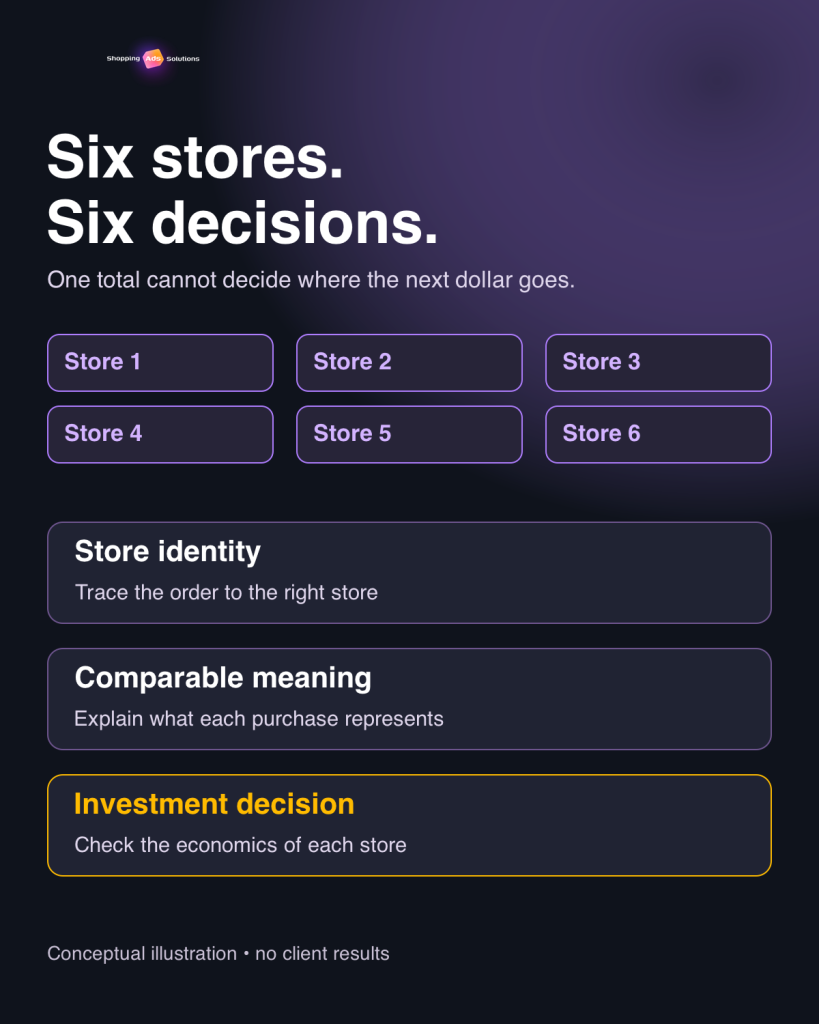
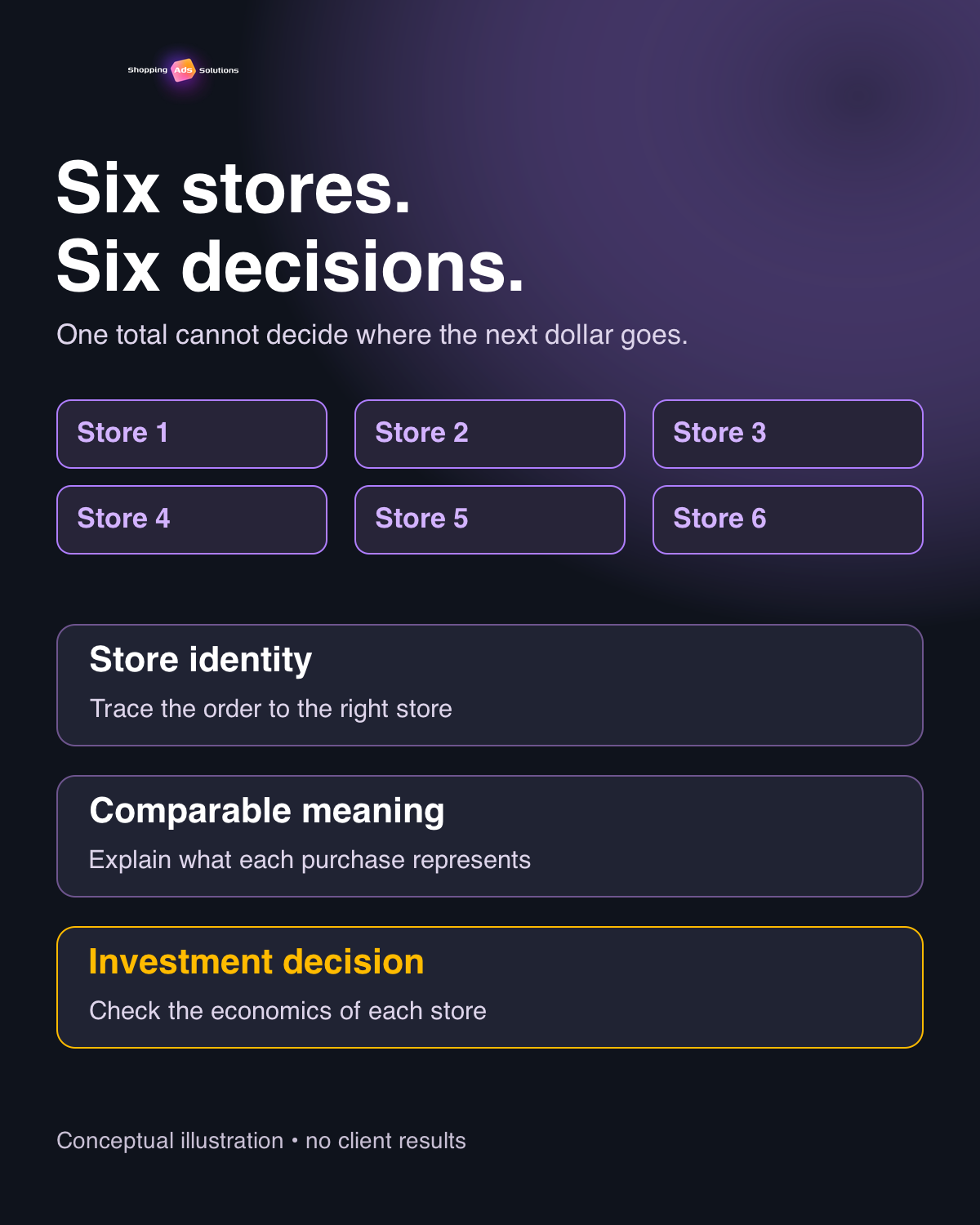
Consider a hypothetical merchant with six distinct storefronts. Some serve different markets; others sell different product ranges. Each has its own orders, operating costs and customer relationships.
The combined dashboard looks reassuring. But the owner needs to decide where to invest next. One store may have expensive fulfillment. Another may depend on discounts to acquire customers. A third may have a repeat-purchase opportunity that still needs evidence. Adding their attributed revenue together does not resolve those differences.
This is an illustration of a decision problem, not a claim about a six-store implementation or client result.
Start with the meaning of purchase
Before comparing stores, agree on the business event being compared. Does each reported purchase represent a completed order? Are values interpreted consistently? When do cancellations and returns enter the comparison? Are the reporting period and attribution basis comparable?
These questions do not require every store to have the same customer journey. They require the comparison to be honest. We recommend agreeing on a common purchase definition, with exceptions that the team can explain.
A different definition can change what the total means. Before increasing budget, resolve that uncertainty instead of treating a tidy report as a sufficient investment reason.
Keep the order attached to its store
We want the connection between the reported purchase and the storefront that produced the order to remain visible. In this hypothetical example, Store A’s order 1001 and Store B’s order 1001 are two separate business records. Matching identifiers alone are not our evidence that the underlying order is the same.
Our question is whether the team can trace a reported purchase to one intended order in the right store, and explain repeated records in that context. Before implementation, the responsible specialist must check the actual destination’s conversion rules; this article does not prescribe platform settings or a universal deduplication rule.
Preserving that context makes the report useful when the owner asks which store should receive the next dollar.
Common currency does not settle the economics
Presenting revenue in a common currency can make a report easier to read. It does not by itself reconcile advertising attribution with store records, resolve reporting-time differences, or show profit.
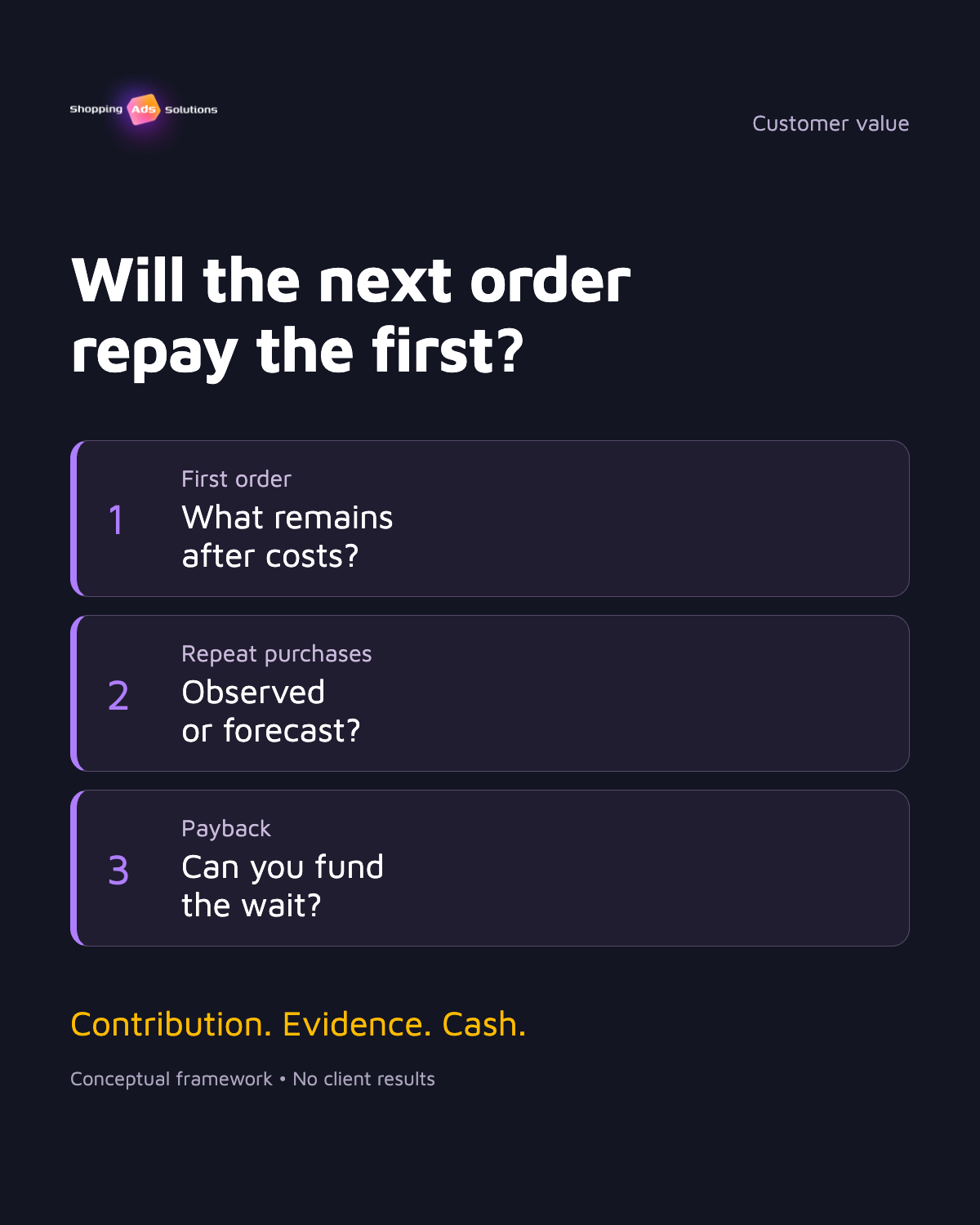
A purchase signal helps describe acquisition. A budget decision also needs relevant costs: product cost, fulfillment, discounts, returns and advertising. Where repeat purchasing matters, its contribution needs supporting evidence rather than an optimistic lifetime-value assumption.
We recommend viewing stores together to understand the portfolio, then separately to decide what changes. Use consistent definitions of contribution and keep them distinct from company-wide net profit. Unknown costs or future orders should stay visible as unknown.
Make one specific investment decision
Choose one storefront before proposing a new portfolio budget. Ask the team to trace a purchase, explain the value and reporting basis, and show the business context behind the proposed increase.
Then state the decision plainly: what changes for this store, why, and what observation would make us reconsider? A valid tracking path is necessary for interpreting a signal; it does not prove that spending more is commercially sound.
At Shopping Ads Solutions, we approach tracking and attribution as part of that business decision. SAS Labs is in development; it is not presented here as an available integration or a replacement for this work.
If your combined report looks healthy but store-level decisions remain unclear, talk with SAS about the measurement questions behind your next investment.
Discuss your multi-store measurement decision