
7 October 2026
Your team delivered another round of ads. Before asking for the next one, ask a more useful question: what can the business now explain that it could not explain before?
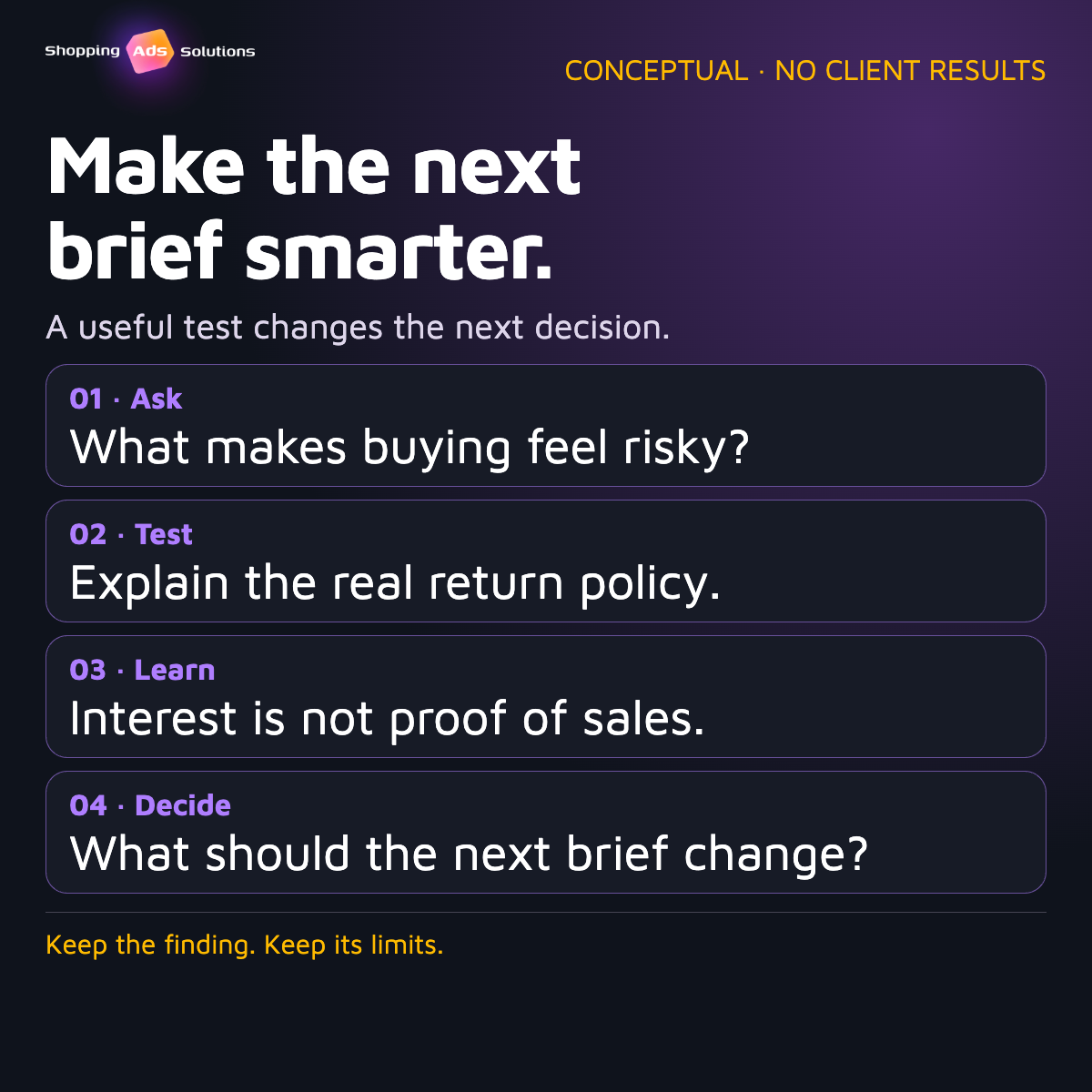
A new asset should answer a new question
A folder full of fresh ads can look like progress. The harder question is whether the business understands its customers any better than it did before those ads were made. If the next brief starts from the same unexamined assumptions, production has moved forward while the thinking has stood still.
At Shopping Ads Solutions, we approach creative as a continuing learning process. We want to know why a particular customer should choose the offer, what still makes that decision difficult, and which message or demonstration is worth testing next. The output is an asset. The purpose is a better commercial decision.
That does not mean every variation needs to be a scientific experiment. Some work repairs an obvious mistake or adapts an established idea to a different format. The team should be clear about which job it is doing. A new crop is useful production work; it is not automatically a new insight about the customer.
Choose the uncertainty before choosing the hook
Start with the buying decision. Are people failing to understand the product, doubting a claim, worrying about delivery, or seeing no reason to choose it over an alternative? These explanations lead to different creative. A faster opening cannot substitute for knowing which question matters.
Customer conversations, permitted reviews, product information and what people do on the website can inform the brief. They are inputs to examine, not a licence to invent a customer insight. A founder’s conviction is valuable context; it is still different from evidence that a particular objection drives purchases.
The ideal customer profile helps specify whom we are trying to understand. A concept is the central idea. An angle gives that idea a particular emphasis; the hook earns enough attention for someone to hear it. Visual direction determines how to make the argument understandable. Those distinctions help the team work. They should not turn a simple brief into a form that obscures the question.
A worked example: price, or the risk of buying?
Consider a hypothetical merchant with a product that visitors examine but do not consistently purchase. The team believes the price is the obstacle and proposes a discount-led ad. Another possibility is that an unfamiliar buyer wants to understand what happens if the product is unsuitable. Neither explanation is a finding yet.
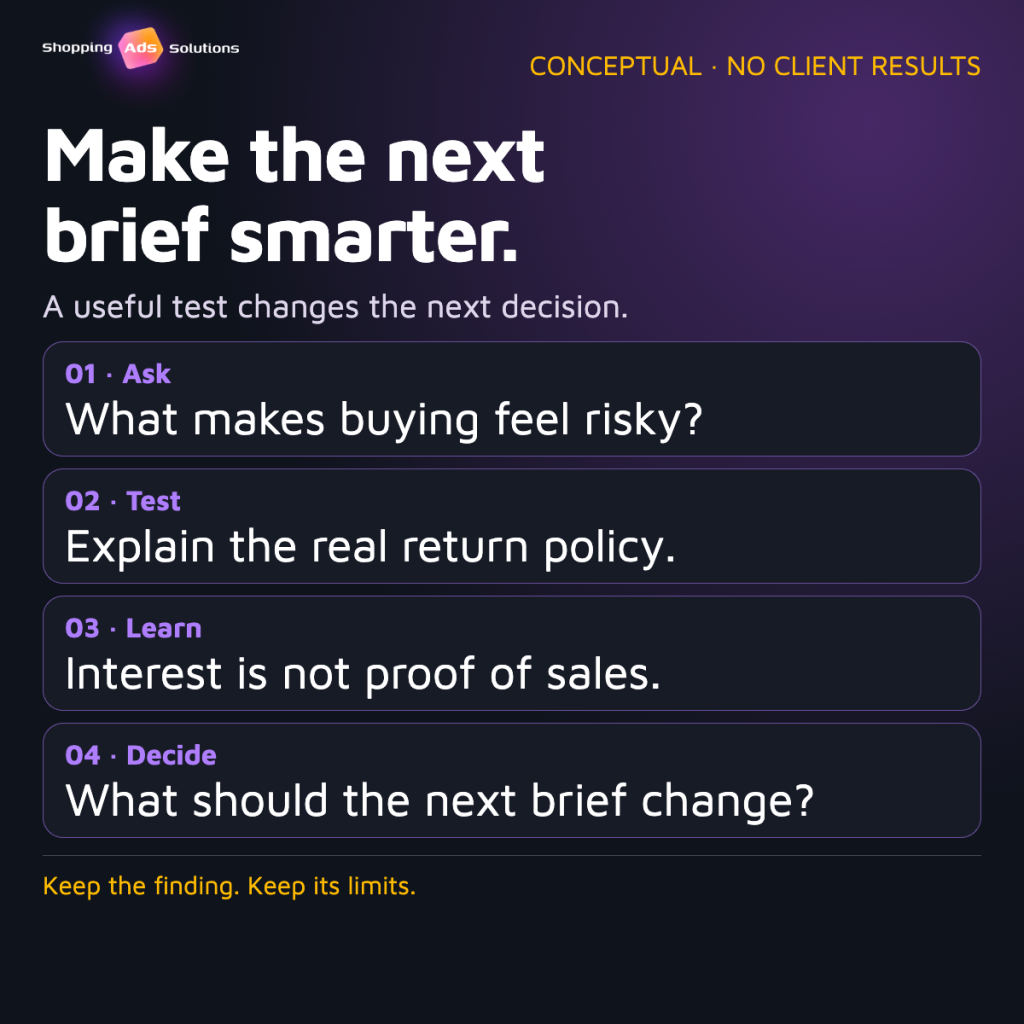
The next creative direction could make the genuine return or exchange policy easier to understand, using an accurate demonstration of the product and a clear explanation of the terms. That is a different argument from “cheaper today.” It must reflect what the business can actually deliver; a reassuring ad cannot invent free returns or remove real conditions.
The useful question is whether clarifying purchase risk deserves further investment. If the team changes the discount, audience, landing page and message together, it may learn whether the complete package is promising. It will have much less basis for saying the explanation itself caused the difference. Keeping the offer and destination reasonably comparable makes interpretation easier, but does not turn ordinary delivery into a controlled causal study.
This is an illustration of our reasoning, not a reported SAS client test. There are no invented results or winning percentages. The price explanation may still be right, both explanations may matter, or neither may be the main constraint.
Follow the response beyond the first few seconds
Attention tells us whether the opening earned a chance to communicate. A click tells us someone wanted to continue. Neither establishes that the message attracted a valuable customer or helped the business make money.
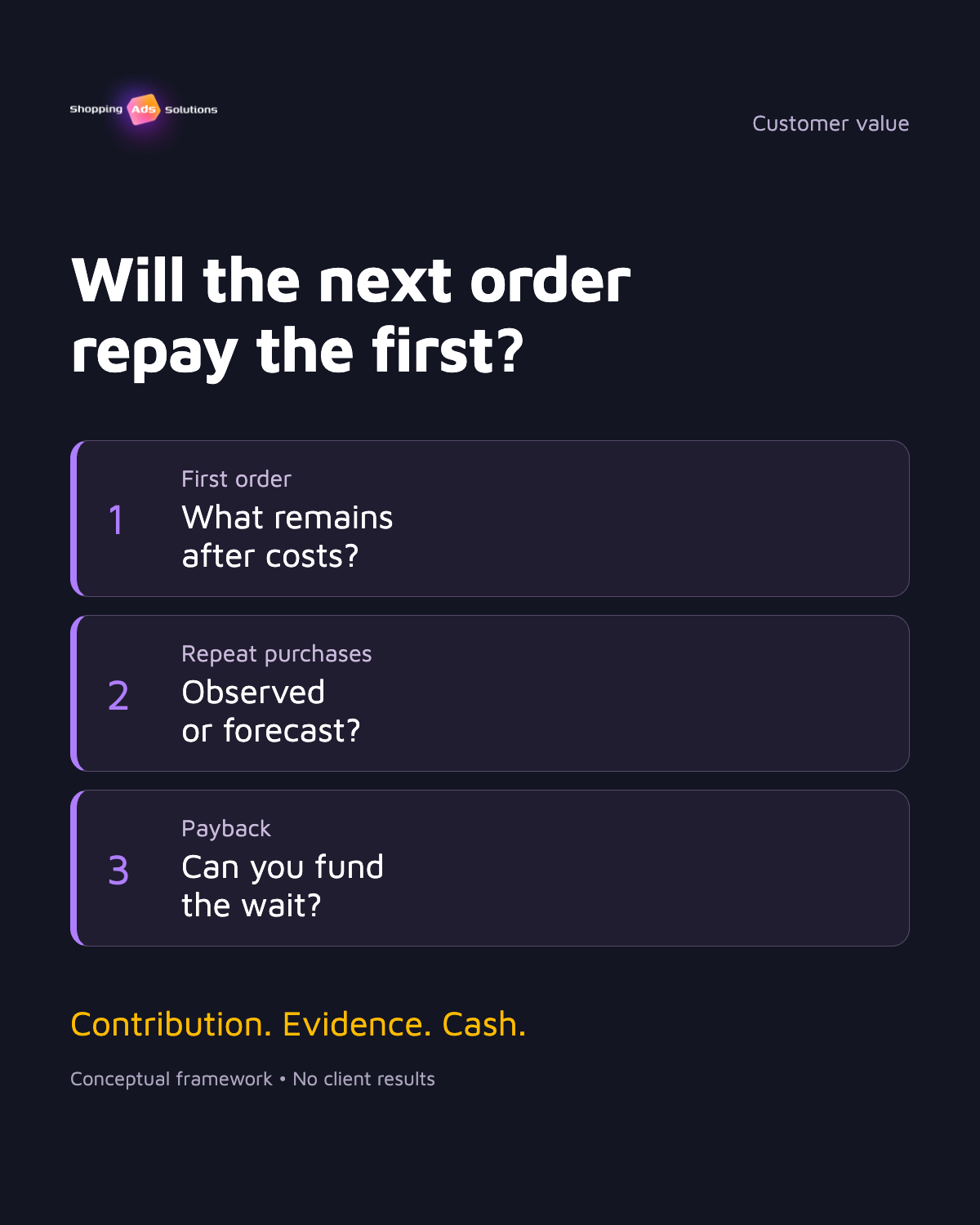
Look at the journey after the click. Did people reach the relevant product information? Did qualified purchase activity follow? Were the resulting orders suitable for the business after discounts, returns and agreed variable costs? Where new-customer acquisition is the goal, separate new purchasing customers from returning buyers.
The available evidence will rarely be perfect. Small volumes, different delivery patterns, incomplete tracking, inventory changes and promotions can all complicate comparison. Record those limits. If the evidence cannot distinguish two explanations, “we cannot tell yet” is a better basis for the next investment than declaring a winner from a pleasing screenshot.
Turn the finding into a better next brief
Suppose the purchase-risk message earns interest, but the product page leaves the policy difficult to find. The next task may be to align the page with the promise before making more versions of the ad. If people understand the policy and still reject the offer, the next brief may need a different reason to buy. These are possible decisions, not outcomes claimed for our hypothetical merchant.
A useful handoff preserves the question, what changed, what was observed, what else could explain it, and the next decision. “This hook worked” is incomplete. “This opening held attention, but we do not yet know whether it improved qualified purchasing” gives the next person something honest to work with.
Keep weak and inconclusive findings as well as promising ones. Reopening an old idea can be sensible when the audience, offer or conditions have changed. Repeating it because nobody remembers why it was set aside is wasted learning.
Use AI to develop the argument, then review the finished work
AI-assisted production can help explore different ways to communicate an idea. The strategic question still comes first. More variations of an unsupported claim do not make that claim more credible, and attractive synthetic imagery does not prove what the product does.
Use materials the business has the right to use. Check product fidelity, claims, brand fit and any applicable disclosure. Preserve real demonstrations when replacing them with synthetic work would mislead the customer. Review the finished words, images and audio, not just the prompt that requested them.
We are also developing Shopping Ads Solutions Labs to support this way of working. The aim is to carry useful context and learning into the next decision. That is a statement of direction, not a claim that an available tool already performs every step, runs tests autonomously or guarantees results.
Evaluate the next round by the decision it improves
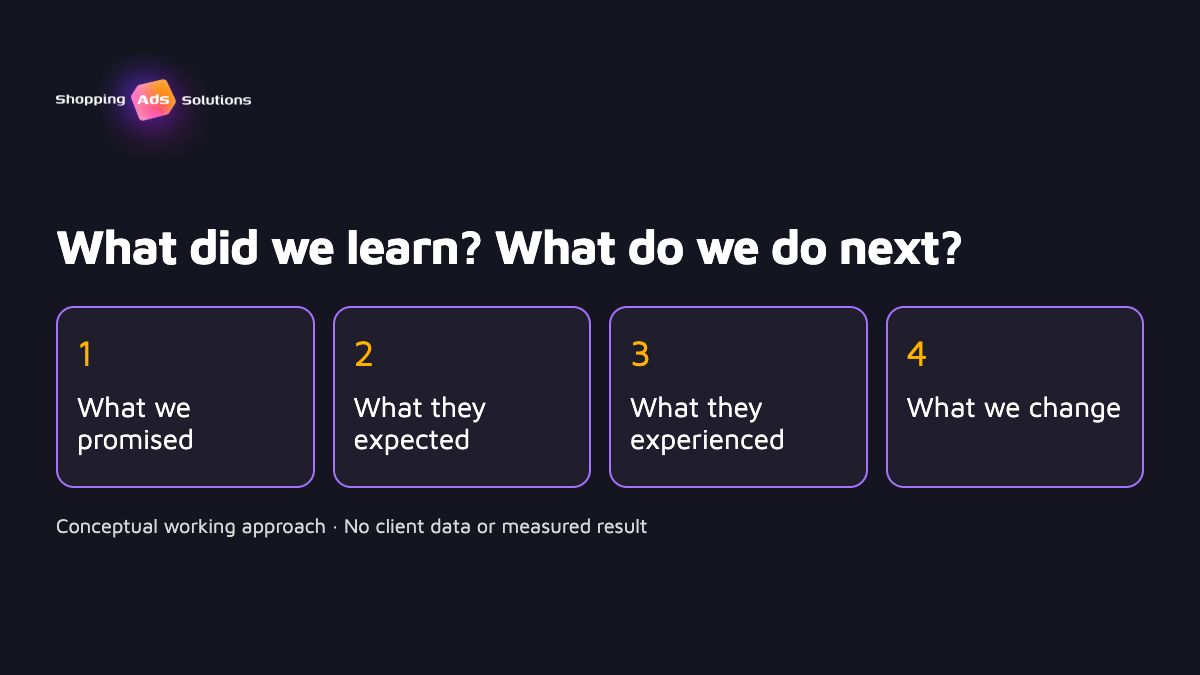
An owner should be able to ask three plain questions: What did we try to understand? What evidence changed our view? What will be different in the next brief? The answers can include a promising direction, a ruled-out assumption, a problem outside the ad, or a decision to wait for better evidence.
A clear answer does not guarantee profitable growth. It makes the creative investment easier to evaluate and the next commitment more deliberate. That is the standard we use: the next round should benefit from what the last round taught us.
Bring us one recent creative test and the question it left unresolved. We can discuss whether the next step is a new message, a stronger demonstration, a better destination or an investigation before producing more assets.
Discuss the question your creative has not answered