

4 October 2026
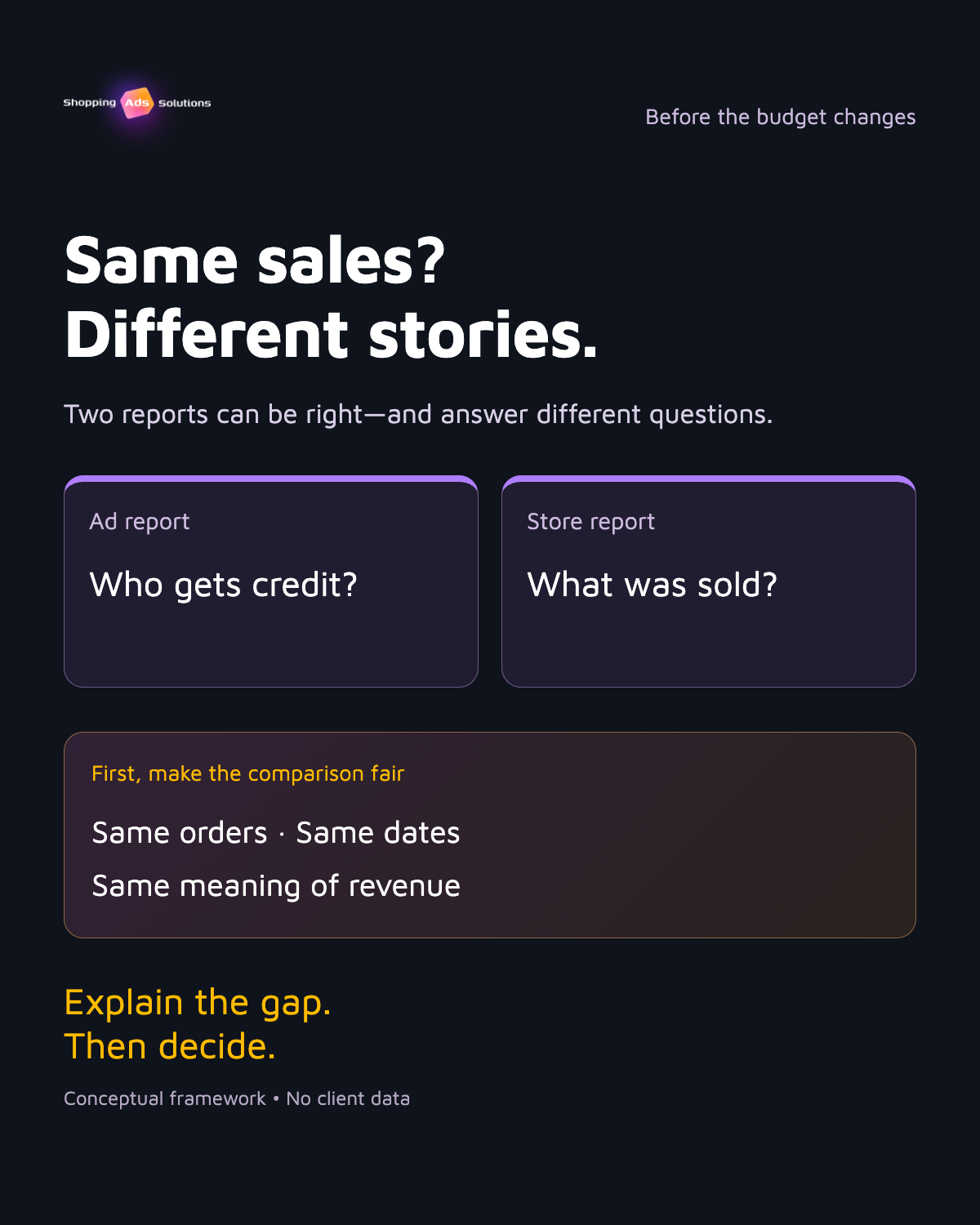
The advertising report says the campaign is producing strong revenue. The store tells a less convincing story. Your team is considering more budget, but first someone needs to explain why the numbers disagree. Different reporting definitions can produce different totals even when the systems are working. A real measurement problem can also hide inside a difference that initially looks routine. At Shopping Ads Solutions, our starting point is to make the comparison meaningful: what is counted, when is it counted, and what claim can the resulting number support? This is a reconciliation framework, not a client case or a promise that every difference can be eliminated.
Ask what decision the disagreement could change
A reporting gap becomes commercially important when it could change the action. Would resolving it alter which campaign receives budget, whether a promotion continues or how confidently you judge new-customer acquisition? Start there rather than assigning the same urgency to every difference.
Identify the exact reports behind the argument. A campaign conversion-value column, an analytics revenue view and a store sales report do not become comparable merely because each contains a currency symbol. Their labels, selected dates and filters are part of the evidence.
Our recommendation is to write the disagreement as a question: does this campaign deserve more spend under the business result we can actually support? That separates an investment decision from a debate over which dashboard looks most authoritative.
Put the revenue definitions beside each other
Before discussing attribution, establish what each amount contains. Is the comparison about product sales, a total including shipping and taxes, or the value passed into an advertising conversion? Check the currency and the selected store, market and sales channel. A shared date range cannot compensate for different boundaries.
Shopify’s sales-report definitions calculate net sales after discounts and sales reversals. Total sales adds other amounts, including taxes and shipping. These are defined reporting measures, not interchangeable names for the same number.
Our recommendation is to choose the store measure that answers the business question, then document how the advertising value relates to it. Do not silently replace one measure with another to make the difference disappear. An expected definition gap is a finding about comparability, not proof of additional profitable demand.
Check which event the date belongs to
The same purchase can appear in different reporting periods when one view follows the advertising interaction and another follows the purchase. Comparing the latest calendar period without recognizing that distinction can turn timing into an apparent performance problem.
Google’s documentation on Google Ads and Analytics discrepancies explains that Google Ads can report the conversion against the click date, while Analytics records it on the date the action occurred. Identify the date basis of the exact columns being compared, alongside the reporting timezone.
Recent periods also deserve a clear observation time. Google Analytics’ documentation says that, with data-driven attribution, conversions can be reattributed for up to seven days. Keep the original snapshot and its extraction time. If the recommendation changes after reporting matures, explain what changed rather than rewriting earlier uncertainty as a confident conclusion.
Separate an order from the credit assigned to it
A store records business activity. An attribution report distributes credit for selected activity under its own rules. These perspectives can both be useful, but attributed value is not another set of orders to add to the store total.
Google Analytics defines attribution as assigning credit along the path to an important action. Google Ads also offers conversion counting choices: every conversion after an interaction or one conversion per ad click or interaction for the selected action. Identify the relevant purchase action and how it is represented. Do not assume that every number labeled conversion is a distinct completed purchase.
Before adding credited revenue across advertising systems, establish whether the underlying orders are mutually exclusive. Independent reports are not automatically a deduplicated business total. A difference warrants investigation; it does not establish either waste or success on its own.
Follow what happened to the order after purchase
The value initially associated with a purchase may not describe the order after cancellation, refund or another adjustment. Ask whether each report reflects the same order state, and whether relevant adjustments have reached the measurement being used.
Shopify documents sales reversals as negative order adjustments and records them on the day they are processed. A period can therefore contain adjustments relating to earlier purchases. An unresolved gap may concern the lifecycle of orders rather than a sudden change in acquisition quality.
Investigate those possibilities against actual permitted order evidence before diagnosing them. Do not assume a cancellation explains the whole difference, or subtract a refund again when the selected store measure already accounts for it. State which differences are explained, which remain unresolved and whether the unresolved part could change the recommendation.
A closer match does not prove incremental revenue
Reconciliation can improve confidence in what the reports describe. It cannot, by itself, establish how many purchases would have disappeared without the advertising. That is a separate causal question.
Our recommendation is to distinguish three conclusions. A definition difference explains why totals vary. A measurement defect means the signal needs repair. A commercial finding changes what you believe about the customers or orders the investment supports. One conclusion should not silently become another.
If the question concerns new-customer acquisition, inspect the relevant customer scope once the reporting comparison is trustworthy. A total including returning purchasers does not answer that narrower question. The scale-readiness dashboard article places reliable measurement beside the wider operating decision. This article addresses the step before that: establishing which revenue comparison is safe to use.
Explain the remaining uncertainty before changing spend
An explained gap can let the team proceed using clearly defined measures. A material unresolved gap can justify limiting the affected decision while the signal is investigated. Neither response requires every report to produce an identical total.
Record what is observed, what remains a hypothesis and what would change the recommendation. If the next action is a budget increase, explain which reconciled evidence supports it. If the next action is a measurement repair, explain which decision that repair will unlock.
Before your next budget meeting, ask which unexplained difference could actually change your investment decision. Our conversion tracking and attribution work addresses the measurement behind that question. Bring both reports and the decision behind them. The purpose is a defensible next action, with the limits still visible.
Discuss the revenue gap behind your budget decision