
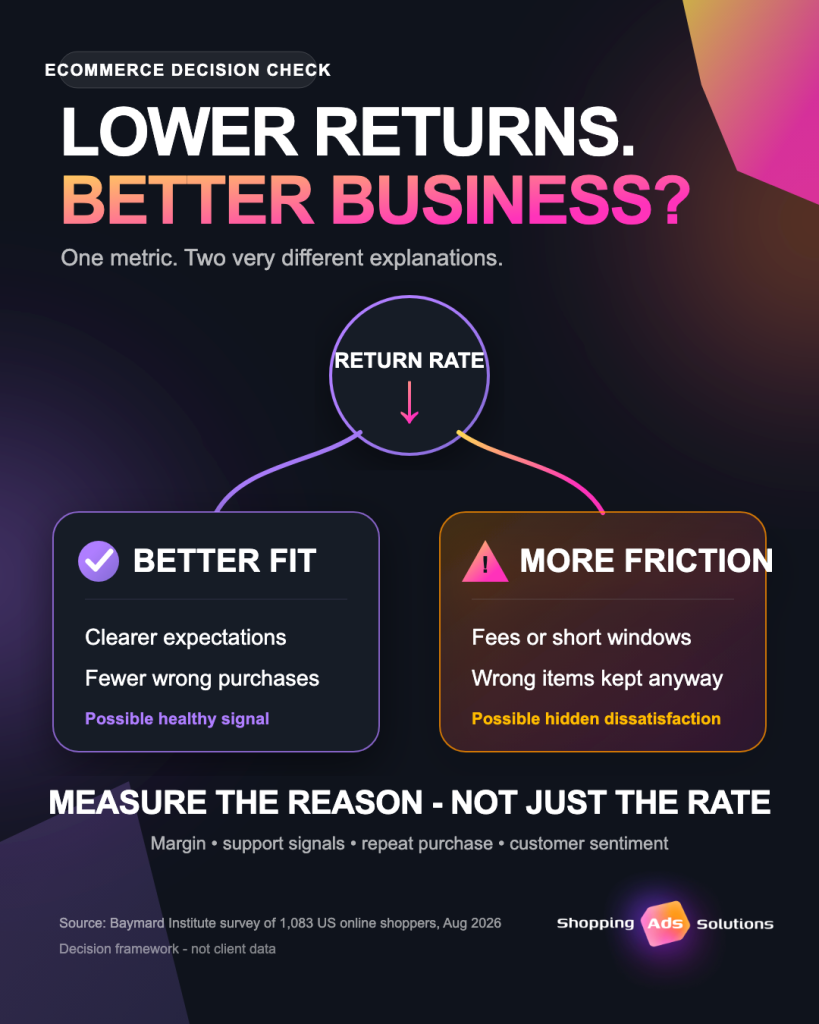
When an eCommerce return rate falls, it is tempting to mark the result as a win.
But the same number can describe two very different customer experiences.
Baymard Institute recently surveyed 1,083 US online shoppers. In its 2026 study, 52% said they had returned at least one online purchase during the previous 12 months. The share who reported making more than one online return fell from 44% in 2024 to 28% in 2026.
Baymard measured shoppers' self-reported return frequency, not an individual retailer's operational return rate. We use that consumer pattern as a prompt for a separate business diagnostic.
That decline may mean shoppers are making better choices and retailers are setting clearer expectations. It may also mean some customers are keeping unsuitable products because returning them feels too expensive or difficult. The survey does not prove which explanation is responsible for the change.
This is why a return rate should be treated as a signal, not a verdict.
Hypothesis 1: product fit improved
A lower return rate can be healthy when the business has reduced preventable mismatches. Product descriptions may be clearer. Sizing or compatibility information may be more useful. Creative and landing pages may be setting more accurate expectations.
The supporting evidence should appear beyond the return-rate number. Preventable return reasons and mismatch-related support contacts should decline, while repeat-purchase behavior should remain healthy or improve.
Hypothesis 2: returning became harder
A lower rate can be misleading when customers face a short return window, fees, unclear instructions, or a difficult support process. Some people may keep the wrong product without becoming satisfied customers.
In that case, the apparent improvement may be accompanied by more complaints, weaker sentiment, lower repeat purchase, or other signs that the first order did not create durable value.
What we would measure next
Before celebrating a lower return rate, we would investigate five connected questions:
- Which return reasons changed, and for which products, sizes, offers, or acquisition cohorts?
- Did support contacts or complaints change during the same period, especially after any return-policy change?
- What contribution remains after refunds, return shipping, discounts, and agreed variable costs?
- Are affected customers purchasing again within a meaningful cohort window?
- Did the acquisition message set an expectation that the product could not meet?
This is the broader measurement principle: one metric should not be forced to answer every business question.
A lower return rate may be good news. It may also hide a problem that has simply moved elsewhere in the customer journey.
Measure the reason, not just the rate.
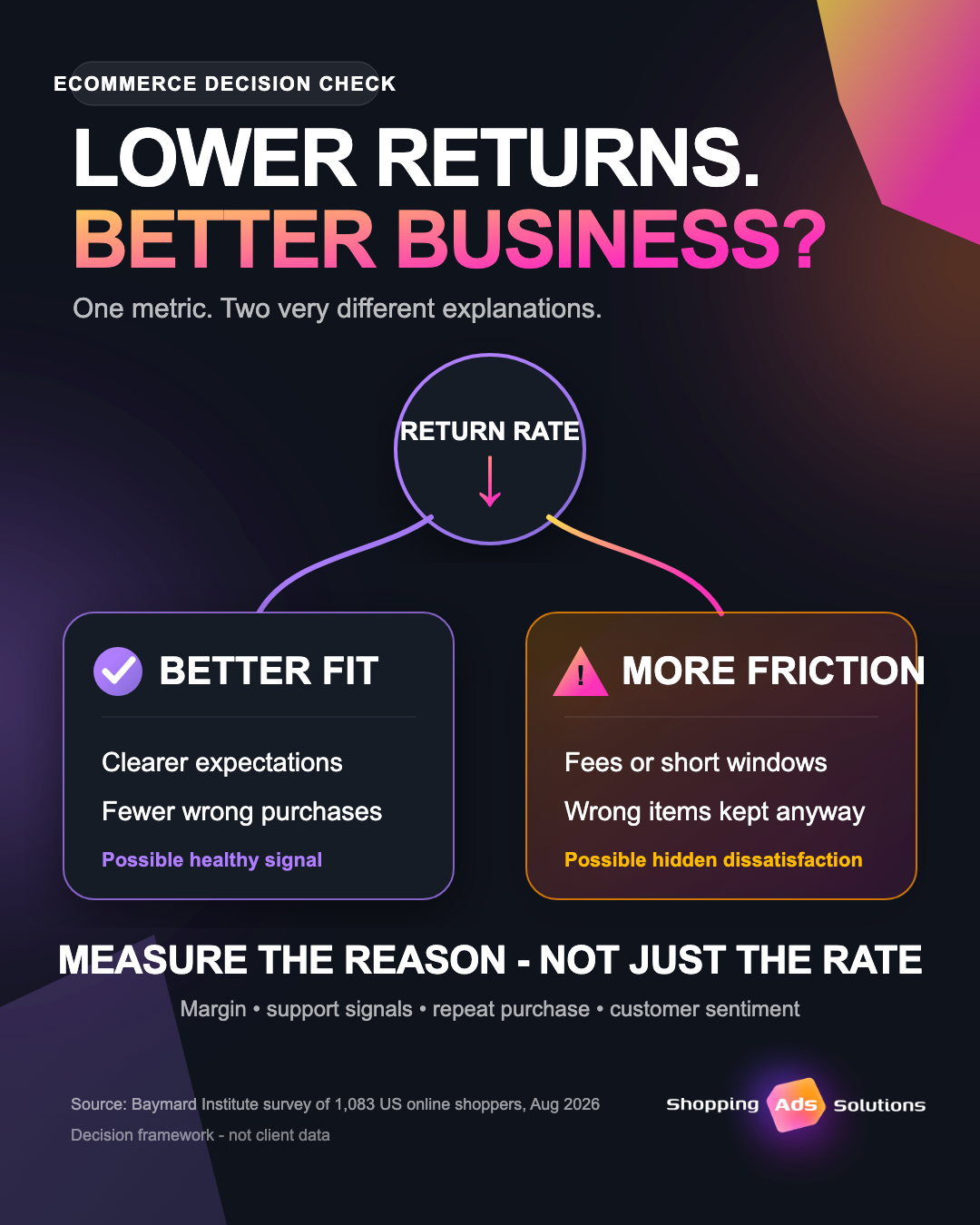
Conceptual decision framework based on the cited Baymard survey. It is not client data and does not establish the cause for a specific retailer.
Connect the metric to the measurement system
Return rate becomes more useful when it is reviewed alongside customer, order, support, and profitability evidence. Learn how Shopping Ads Solutions approaches conversion tracking and attribution and how acquisition promises connect to eCommerce paid-social strategy.
For another example of why a stronger advertising metric can hide a weaker commercial outcome, read More Google Ads Spend, Less Revenue.
For a measurement case that traces a commercial action across several systems, see the appliance retailer conversion tracking case. Its evidence supports signal coverage and attribution, not a revenue or performance lift.
Want us to inspect the measurement chain behind your metric? Talk to Shopping Ads Solutions.
About the author: Michael Chachashvili is a founder of Shopping Ads Solutions and works on paid acquisition, measurement, and profitable growth systems for eCommerce and service businesses.
Editorial process: AI assisted with drafting and visual production. Michael Chachashvili is responsible for the final interpretation and publication decision.