
The calls existed, but a fixed source-tracking number did not preserve the visitor-level paid-click association required by CallRail’s standard Google Ads import. The result was recorded calls in one system and zero imported call conversions in the other.
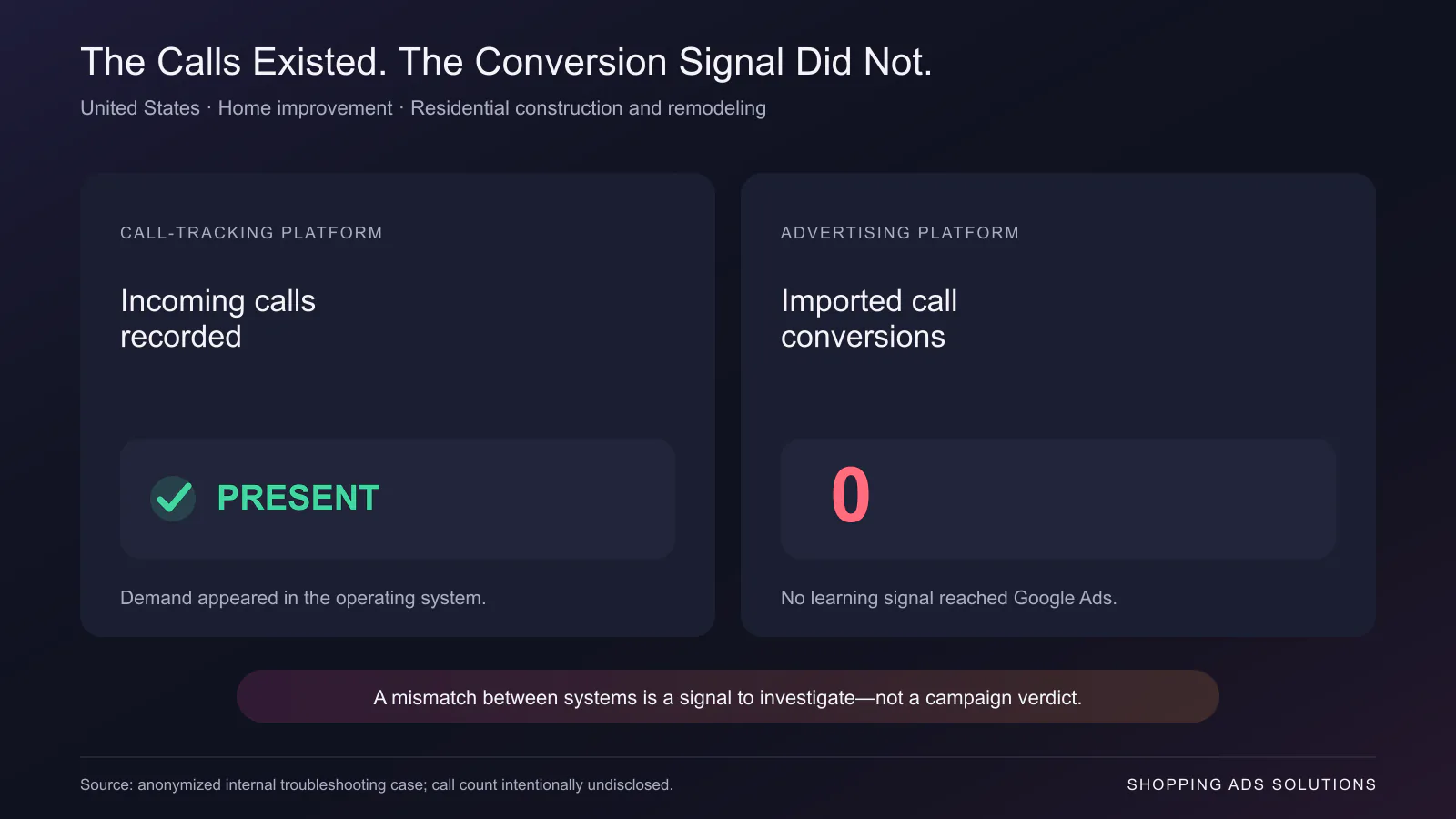
One platform showed incoming calls.
The other showed zero imported call conversions.
The business was an established US service company:
- Market: United States.
- Niche: Home improvement.
- Sub-niche: Residential construction and remodeling.
Evidence note — updated August 6, 2026: This anonymized Shopping Ads Solutions troubleshooting record confirms that CallRail contained calls, the relevant Google Ads import showed zero conversions, and the calls entered through a fixed source tracker. The approved source does not provide a publishable reporting period, call count, controlled post-fix validation, or performance result, so none is claimed. Client identity and raw account details remain private. CallRail’s linked documentation was rechecked on August 6, 2026.
Phone inquiries mattered because a call could become a qualified estimate, a scheduled consultation, and eventually a high-value project. But Google Ads was receiving no useful signal from the calls recorded in CallRail.
The easy conclusion would have been that the campaigns were failing to generate phone leads.
That conclusion would have been wrong.
The short version: The demand signal existed, but the measurement path was broken. Calls were reaching a fixed source-tracking number rather than a visitor-level website pool. CallRail could record the calls, but its standard Google Ads integration could not connect those calls to the paid visitors who generated them. Google Ads therefore received zero imported call conversions.
The important question was not, “Why aren’t people calling?”
It was, “At which point did the call stop carrying the information Google Ads needed?”
Two dashboards were telling different stories
The initial signal was a contradiction.
CallRail contained calls. Google Ads contained no imported call conversions from those calls.
That distinction matters. Zero conversions inside an advertising platform can mean at least two very different things:
- The campaign generated no valuable action.
- The action happened, but the measurement system failed to report it.
Those situations require different decisions.
If demand is genuinely absent, the business may need to reconsider its offer, targeting, search terms, landing page, location coverage, or campaign economics.
If demand exists but the conversion path is broken, changing the campaigns first can make the account worse. The business may pause useful traffic, move budgets, or change bidding based on incomplete evidence.
We investigated the path, not only the settings
There were several plausible explanations.
The Google Ads integration could have been inactive. The wrong advertising account could have been connected. Auto-tagging could have been disabled. The conversion action could have been configured incorrectly. The reporting window could have been too narrow. Or the calls might have been reaching a number that was never designed to preserve visitor-level attribution.
Checking whether an integration says “active” is not enough to distinguish those possibilities.
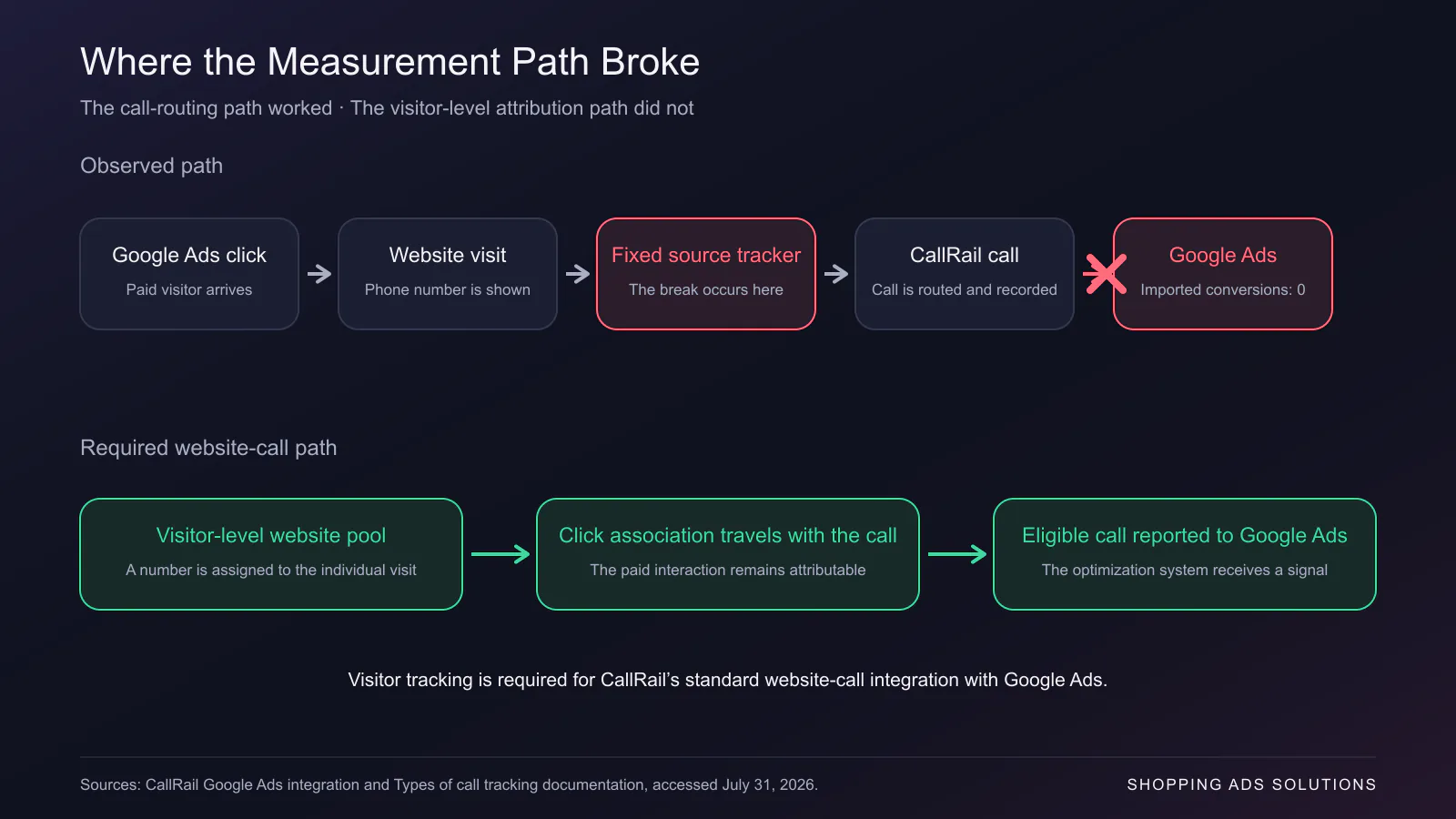
We traced the event through the systems:
- A prospective customer clicked a Google ad.
- The visitor reached the company’s website or landing page.
- A phone number was displayed.
- The prospect called.
- CallRail recorded the call.
- CallRail attempted to associate the call with the advertising visit.
- Google Ads needed an eligible click-linked event before it could record the imported conversion.
The break was at step six.
The number receiving the calls was a fixed source-tracking number.
Source-level tracking can tell a business that calls came through a particular campaign or marketing source. It uses one number for that source. But it does not create the same visitor-level relationship as a website pool that dynamically assigns numbers to individual visitors.
That difference was decisive.
CallRail’s current Google Ads integration documentation states that visitor tracking is required and that only calls to the website pool with Google Ads as the source are reported through the integration. Calls to source trackers are not reported as conversions through that path.
Its separate comparison of visitor-level and source-level call tracking also shows that Google Ads integration and the visitor timeline are supported for visitor tracking, but not for source tracking.
The calls were real. The missing conversion signal was also real. Both dashboards were accurately describing the part of the system they could see.
Where the measurement path broke
With visitor-level call tracking, a website pool swaps numbers for individual visitors. That allows the call-tracking system to connect a call to the relevant visit and the advertising click information associated with it.
In this case, the fixed source number still routed and recorded the call. What it did not provide was the visitor-level connection required by the standard CallRail-to-Google Ads conversion path.
This is why the visible symptom—zero conversions—could not be interpreted as zero demand.
It was evidence of zero successfully imported conversions through that tracking path.
What the investigation supported
The evidence supported three conclusions.
1. We did not yet have a trustworthy campaign outcome
Google Ads could not use the missing imported calls to tell us which clicks produced phone inquiries.
That meant campaign-level cost per call, keyword quality, and bidding performance could not be judged from the imported call conversion action alone.
2. The overall integration was not necessarily “broken”
The configuration could be active and still receive no eligible events.
The issue was more specific: the calls were entering through a tracking method that did not provide the visitor-level connection required by the integration.
3. Campaign changes were not the first priority
Before changing targeting, budgets, or bidding, the business needed a trustworthy measurement path.
Google Ads warns that the distinction between primary, biddable conversions and secondary, observation-only actions is critical because automated bidding relies on those signals. Its guidance on importing phone call conversions also separates calls from ads, calls from a website, and calls supplied through uploads because they require different measurement paths.
An algorithm cannot optimize toward a qualified phone inquiry that never reaches it.
What we changed in the decision process
The immediate decision was not to declare the campaigns unsuccessful.
It was to correct and validate the measurement architecture before using the call-conversion data to make budget or bidding decisions.
The required path was clear:
- Website calls from paid visitors needed visitor-level tracking rather than the fixed source tracker.
- The website tracking script, Google Ads auto-tagging, account connection, and conversion action needed to be checked as one system.
- A controlled paid-visit test needed to confirm that the displayed number, CallRail visitor record, advertising click information, and Google Ads conversion all remained connected.
- Reporting needed enough processing time before the test was judged.
This was not about chasing a platform setting. It was about proving that the complete commercial event could travel from a prospect’s ad click to a business outcome and back into the system responsible for optimization.
The larger problem was not reporting—it was learning
A missing conversion creates more than an inaccurate dashboard. It is a different failure from buying more traffic that produces weaker business results, but both cases show why the dashboard alone is not the diagnosis.
It changes what the advertising system learns.
For a construction or remodeling business, not every call has equal value. Some callers are outside the service area. Some want work the company does not provide. Some are researching. Others become qualified estimates and signed projects.
Recording the first phone call is therefore only the beginning. The useful long-term measurement chain is:
Paid interaction → phone inquiry → qualified opportunity → estimate or consultation → won project → revenue
But that chain cannot be improved if it breaks at the first handoff.
The fixed source number allowed the business to answer the phone. It did not give Google Ads the visitor-level evidence needed through CallRail’s normal integration.
That is the difference between call routing and performance measurement.
When calls exist but Google Ads cannot see them
The lesson is not that every zero-conversion account has a tracking problem.
The lesson is that zero inside one platform is not a complete diagnosis.
When a service business receives calls but the advertising account receives no corresponding signal, we compare the systems before changing the campaigns. We trace the real customer action, identify where its attribution disappears, and validate the complete path.
That is how Shopping Ads Solutions approaches paid growth: the campaign, website, call handling, sales process, and business outcome must operate as one measurable system. See our broader data and analytics work.
If your business is already investing seriously in advertising but the reported leads do not match what your team experiences, the Shopping Ads Solutions paid growth audit is designed to locate that disconnect. Request the audit here. If we subsequently work together, the audit fee is credited toward the agreed contract.
About the author: Michael Chachashvili is a founder of Shopping Ads Solutions and works on paid acquisition, measurement, and profitable growth systems for eCommerce and service businesses. Published July 31, 2026; updated August 6, 2026.